<?xml version='1.0' encoding='utf-8' ?>
<otrunk id='8a8867d6-39f4-11de-be03-001ff3caa767'>
  <imports>
    <import class='org.concord.otrunk.OTSystem' />
    <import class='org.concord.framework.otrunk.view.OTFrame' />
    <import class='org.concord.otrunk.view.OTViewEntry' />
    <import class='org.concord.otrunk.view.OTViewBundle' />
    <import class='org.concord.otrunk.view.document.OTDocumentViewConfig' />
    <import class='org.concord.otrunk.view.document.OTCssText' />
    <import class='org.concord.sensor.state.OTDeviceConfig' />
    <import class='org.concord.sensor.state.OTExperimentRequest' />
    <import class='org.concord.sensor.state.OTInterfaceManager' />
    <import class='org.concord.sensor.state.OTSensorDataProxy' />
    <import class='org.concord.sensor.state.OTSensorRequest' />
    <import class='org.concord.otrunk.view.document.OTCompoundDoc' />
    <import class='org.concord.otrunk.ui.OTText' />
    <import class='org.concord.otrunk.ui.question.OTQuestion' />
    <import class='org.concord.otrunk.ui.OTChoice' />
    <import class='org.concord.graph.util.state.OTDrawingTool2' />
    <import class='org.concord.framework.otrunk.wrapper.OTBlob' />
    <import class='org.concord.data.state.OTDataTable' />
    <import class='org.concord.data.state.OTDataChannelDescription' />
    <import class='org.concord.data.state.OTDataField' />
    <import class='org.concord.data.state.OTDataStore' />
    <import class='org.concord.datagraph.state.OTDataAxis' />
    <import class='org.concord.datagraph.state.OTDataCollector' />
    <import class='org.concord.datagraph.state.OTDataGraph' />
    <import class='org.concord.datagraph.state.OTDataGraphable' />
    <import class='org.concord.datagraph.state.OTMultiDataGraph' />
    <import class='org.concord.datagraph.state.OTPluginView' />
    <import class='org.concord.otrunk.control.OTButton' />
    <import class='org.concord.sensor.state.OTZeroSensor' />
    <import class='org.concord.otrunk.ui.OTUDLContainer' />
    <import class='org.concord.otrunk.ui.OTCardContainer' />
    <import class='org.concord.otrunk.ui.OTCurriculumUnit' />
    <import class='org.concord.otrunk.ui.OTSection' />
    <import class='org.concord.otrunk.ui.menu.OTMenu' />
    <import class='org.concord.otrunk.ui.menu.OTMenuRule' />
    <import class='org.concord.otrunk.ui.menu.OTNavBar' />
    <import class='org.concord.otrunk.view.OTViewChild' />
  </imports>
  <objects>
    <OTSystem>
            <bundles>
              <OTViewBundle showLeftPanel='false'>
        <frame>
          <OTFrame height='700' title='Discovering Relative Humidity and Dew Point' useScrollPane='false' width='1140'>    </OTFrame>
        </frame>
        <views>
          <OTViewEntry local_id='text_edit_view' objectClass='org.concord.otrunk.ui.OTText' viewClass='org.concord.otrunk.ui.swing.OTTextEditView' />
          <OTViewEntry local_id='question_view' objectClass='org.concord.otrunk.ui.question.OTQuestion' viewClass='org.concord.otrunk.ui.question.OTQuestionView' />
          <OTViewEntry local_id='choice_radio_button_view' objectClass='org.concord.otrunk.ui.OTChoice' viewClass='org.concord.otrunk.ui.swing.OTChoiceRadioButtonView' />
          <OTViewEntry local_id='data_drawing_tool2_view' objectClass='org.concord.graph.util.state.OTDrawingTool2' viewClass='org.concord.datagraph.state.OTDataDrawingToolView' />
          <OTViewEntry local_id='blob_image_view' objectClass='org.concord.framework.otrunk.wrapper.OTBlob' viewClass='org.concord.otrunk.ui.swing.OTBlobImageView' />
          <OTViewEntry local_id='data_collector_view' objectClass='org.concord.datagraph.state.OTDataCollector' viewClass='org.concord.datagraph.state.OTDataCollectorView' />
          <OTViewEntry local_id='data_graph_view' objectClass='org.concord.datagraph.state.OTDataGraph' viewClass='org.concord.datagraph.state.OTDataGraphView' />
          <OTViewEntry local_id='data_field_view' objectClass='org.concord.data.state.OTDataField' viewClass='org.concord.data.state.OTDataFieldView' />
          <OTViewEntry local_id='data_drawing_tool_view' objectClass='org.concord.graph.util.state.OTDrawingTool' viewClass='org.concord.datagraph.state.OTDataDrawingToolView' />
          <OTViewEntry local_id='multi_data_graph_view' objectClass='org.concord.datagraph.state.OTMultiDataGraph' viewClass='org.concord.datagraph.state.OTMultiDataGraphView' />
          <OTViewEntry local_id='button_view' objectClass='org.concord.otrunk.control.OTButton' viewClass='org.concord.otrunk.control.OTButtonView' />
          <OTViewEntry local_id='data_table_view' objectClass='org.concord.data.state.OTDataTable' viewClass='org.concord.data.state.OTDataTableView' />
          <OTViewEntry local_id='udl_container' objectClass='org.concord.otrunk.ui.OTUDLContainer' viewClass='org.concord.otrunk.ui.OTUDLContainerView' />
          <OTViewEntry local_id='curriculum_unit_view' objectClass='org.concord.otrunk.ui.OTCurriculumUnit' viewClass='org.concord.otrunk.ui.swing.OTCurriculumUnitView' />
          <OTViewEntry local_id='section_view' objectClass='org.concord.otrunk.ui.OTSection' viewClass='org.concord.otrunk.ui.swing.OTSectionView' />
          <OTViewEntry local_id='menu_page_view' objectClass='org.concord.otrunk.ui.menu.OTMenu' viewClass='org.concord.otrunk.ui.menu.OTMenuPageView' />
          <OTViewEntry local_id='menu_accordion_section_view' objectClass='org.concord.otrunk.ui.menu.OTMenu' viewClass='org.concord.otrunk.swingx.OTMenuAccordionSectionView' />
          <OTViewEntry local_id='menu_section_view' objectClass='org.concord.otrunk.ui.menu.OTMenu' viewClass='org.concord.otrunk.ui.menu.OTMenuSectionView' />
          <OTViewEntry local_id='menu_page_expand_view' objectClass='org.concord.otrunk.ui.menu.OTMenu' viewClass='org.concord.otrunk.ui.menu.OTMenuPageExpandView' />
          <OTViewEntry local_id='card_container_view' objectClass='org.concord.otrunk.ui.OTCardContainer' viewClass='org.concord.otrunk.ui.swing.OTCardContainerView' />
          <OTViewEntry local_id='nav_bar' objectClass='org.concord.otrunk.ui.menu.OTNavBar' viewClass='org.concord.otrunk.ui.menu.OTNavBarView' />
          <OTDocumentViewConfig objectClass='org.concord.otrunk.view.document.OTDocument' viewClass='org.concord.otrunk.view.document.OTDocumentView'>
            <cssBlocks>
              <OTCssText local_id='otml_css' src='stylesheets/otml.css' />
            </cssBlocks>
          </OTDocumentViewConfig>
        </views>
      </OTViewBundle>
      
              <OTInterfaceManager>
        <deviceConfigs>
          <OTDeviceConfig configString='none' deviceId='10'>    </OTDeviceConfig>
        </deviceConfigs>
      </OTInterfaceManager>
      
            </bundles>
      <root>
        <OTUDLContainer leftPanelWidth='300'>
          <title>
            <OTCompoundDoc>
              <bodyText>
                <div id='content'>
                  <h3>Discovering Relative Humidity and Dew Point</h3>
                </div>
              </bodyText>
            </OTCompoundDoc>
          </title>
          <menu>
            <OTViewChild scrollPanelHasBorder='false' useHorizontalScrollPane='false' useScrollPane='true'>
              <object>
                <object refid='${menu_investigation_626}' />
              </object>
              <viewid>
                <object refid='${menu_accordion_section_view}' />
              </viewid>
            </OTViewChild>
          </menu>
          <content>
            <OTCardContainer contentsMayScroll='false' local_id='section_card_container_investigation_626'>
              <cards>
                <OTSection local_id='section_1370' name='Thermocouple - probe construction'>
                  <header>
                    <OTCompoundDoc local_id='header_section_1370'>
                      <bodyText>
                        <div id='content'>
                          <h1>Thermocouple - probe construction</h1>
                        </div>
                      </bodyText>
                    </OTCompoundDoc>
                  </header>
                  <content>
                    <OTCardContainer contentsMayScroll='true' local_id='page_card_container_section_1370'>
                      <cards>
                        <OTCompoundDoc local_id='page_4713' name='Introduction'>
                          <bodyText>
                            <div id='content'>
                              <h2>Introduction</h2>
                              <div class='element'>
                                <object refid='${xhtml_5062}' />
                              </div>
                            </div>
                          </bodyText>
                        </OTCompoundDoc>
                        <OTCompoundDoc local_id='page_4714' name='Materials'>
                          <bodyText>
                            <div id='content'>
                              <h2>Materials</h2>
                              <div class='element'>
                                <object refid='${xhtml_5063}' />
                              </div>
                            </div>
                          </bodyText>
                        </OTCompoundDoc>
                        <OTCompoundDoc local_id='page_4715' name='Safety'>
                          <bodyText>
                            <div id='content'>
                              <h2>Safety</h2>
                              <div class='element'>
                                <object refid='${xhtml_5064}' />
                              </div>
                            </div>
                          </bodyText>
                        </OTCompoundDoc>
                        <OTCompoundDoc local_id='page_4716' name='Procedure'>
                          <bodyText>
                            <div id='content'>
                              <h2>Procedure</h2>
                              <div class='element'>
                                <object refid='${xhtml_5065}' />
                              </div>
                            </div>
                          </bodyText>
                        </OTCompoundDoc>
                        <OTCompoundDoc local_id='page_4717' name='Collect Data'>
                          <bodyText>
                            <div id='content'>
                              <h2>Collect Data</h2>
                              <div class='element'>
                                <object refid='${xhtml_5066}' />
                              </div>
                              <div class='element'>
                                <object refid='${data_collector_978}' />
                              </div>
                              <div class='element'>
                                <object refid='${data_collector_979}' />
                              </div>
                            </div>
                          </bodyText>
                        </OTCompoundDoc>
                      </cards>
                      <currentCard>
                        <object refid='${page_4713}' />
                      </currentCard>
                      <viewedCards></viewedCards>
                    </OTCardContainer>
                  </content>
                  <footer>
                    <object refid='${menu_section_1370}' />
                  </footer>
                </OTSection>
                <OTSection local_id='section_1369' name='Relative humidity measurement'>
                  <header>
                    <OTCompoundDoc local_id='header_section_1369'>
                      <bodyText>
                        <div id='content'>
                          <h1>Relative humidity measurement</h1>
                        </div>
                      </bodyText>
                    </OTCompoundDoc>
                  </header>
                  <content>
                    <OTCardContainer contentsMayScroll='true' local_id='page_card_container_section_1369'>
                      <cards>
                        <OTCompoundDoc local_id='page_4705' name='Introduction'>
                          <bodyText>
                            <div id='content'>
                              <h2>Introduction</h2>
                              <div class='element'>
                                <object refid='${xhtml_5054}' />
                              </div>
                              <div class='element'>
                                <object refid='${open_response_1537}' />
                              </div>
                            </div>
                          </bodyText>
                        </OTCompoundDoc>
                        <OTCompoundDoc local_id='page_4706' name='Standards'>
                          <bodyText>
                            <div id='content'>
                              <h2>Standards</h2>
                              <div class='element'>
                                <object refid='${xhtml_5055}' />
                              </div>
                            </div>
                          </bodyText>
                        </OTCompoundDoc>
                        <OTCompoundDoc local_id='page_4707' name='Materials'>
                          <bodyText>
                            <div id='content'>
                              <h2>Materials</h2>
                              <div class='element'>
                                <object refid='${xhtml_5056}' />
                              </div>
                            </div>
                          </bodyText>
                        </OTCompoundDoc>
                        <OTCompoundDoc local_id='page_4708' name='Safety'>
                          <bodyText>
                            <div id='content'>
                              <h2>Safety</h2>
                              <div class='element'>
                                <object refid='${xhtml_5057}' />
                              </div>
                            </div>
                          </bodyText>
                        </OTCompoundDoc>
                        <OTCompoundDoc local_id='page_4709' name='Procedure'>
                          <bodyText>
                            <div id='content'>
                              <h2>Procedure</h2>
                              <div class='element'>
                                <object refid='${xhtml_5058}' />
                              </div>
                            </div>
                          </bodyText>
                        </OTCompoundDoc>
                        <OTCompoundDoc local_id='page_4710' name='Collect Data'>
                          <bodyText>
                            <div id='content'>
                              <h2>Collect Data</h2>
                              <div class='element'>
                                <object refid='${xhtml_5059}' />
                              </div>
                              <div class='element'>
                                <object refid='${data_collector_976}' />
                              </div>
                              <div class='element'>
                                <object refid='${open_response_1538}' />
                              </div>
                              <div class='element'>
                                <object refid='${data_collector_977}' />
                              </div>
                            </div>
                          </bodyText>
                        </OTCompoundDoc>
                        <OTCompoundDoc local_id='page_4711' name='Analysis'>
                          <bodyText>
                            <div id='content'>
                              <h2>Analysis</h2>
                              <div class='element'>
                                <object refid='${xhtml_5060}' />
                              </div>
                            </div>
                          </bodyText>
                        </OTCompoundDoc>
                        <OTCompoundDoc local_id='page_4712' name='Conclusion'>
                          <bodyText>
                            <div id='content'>
                              <h2>Conclusion</h2>
                              <div class='element'>
                                <object refid='${xhtml_5061}' />
                              </div>
                            </div>
                          </bodyText>
                        </OTCompoundDoc>
                      </cards>
                      <currentCard>
                        <object refid='${page_4705}' />
                      </currentCard>
                      <viewedCards></viewedCards>
                    </OTCardContainer>
                  </content>
                  <footer>
                    <object refid='${menu_section_1369}' />
                  </footer>
                </OTSection>
                <OTSection local_id='section_1371' name='Relative humidity measurement - Probe kit'>
                  <header>
                    <OTCompoundDoc local_id='header_section_1371'>
                      <bodyText>
                        <div id='content'>
                          <h1>Relative humidity measurement - Probe kit</h1>
                        </div>
                      </bodyText>
                    </OTCompoundDoc>
                  </header>
                  <content>
                    <OTCardContainer contentsMayScroll='true' local_id='page_card_container_section_1371'>
                      <cards>
                        <OTCompoundDoc local_id='page_4718' name='Introduction'>
                          <bodyText>
                            <div id='content'>
                              <h2>Introduction</h2>
                              <div class='element'>
                                <object refid='${xhtml_5067}' />
                              </div>
                              <div class='element'>
                                <object refid='${open_response_1539}' />
                              </div>
                            </div>
                          </bodyText>
                        </OTCompoundDoc>
                        <OTCompoundDoc local_id='page_4719' name='Standards'>
                          <bodyText>
                            <div id='content'>
                              <h2>Standards</h2>
                              <div class='element'>
                                <object refid='${xhtml_5068}' />
                              </div>
                            </div>
                          </bodyText>
                        </OTCompoundDoc>
                        <OTCompoundDoc local_id='page_4720' name='Materials'>
                          <bodyText>
                            <div id='content'>
                              <h2>Materials</h2>
                              <div class='element'>
                                <object refid='${xhtml_5069}' />
                              </div>
                            </div>
                          </bodyText>
                        </OTCompoundDoc>
                        <OTCompoundDoc local_id='page_4721' name='Safety'>
                          <bodyText>
                            <div id='content'>
                              <h2>Safety</h2>
                              <div class='element'>
                                <object refid='${xhtml_5070}' />
                              </div>
                            </div>
                          </bodyText>
                        </OTCompoundDoc>
                        <OTCompoundDoc local_id='page_4722' name='Procedure'>
                          <bodyText>
                            <div id='content'>
                              <h2>Procedure</h2>
                              <div class='element'>
                                <object refid='${xhtml_5071}' />
                              </div>
                              <div class='element'>
                                <object refid='${data_collector_980}' />
                              </div>
                            </div>
                          </bodyText>
                        </OTCompoundDoc>
                        <OTCompoundDoc local_id='page_4723' name='Analysis'>
                          <bodyText>
                            <div id='content'>
                              <h2>Analysis</h2>
                              <div class='element'>
                                <object refid='${xhtml_5072}' />
                              </div>
                            </div>
                          </bodyText>
                        </OTCompoundDoc>
                        <OTCompoundDoc local_id='page_4724' name='Conclusion'>
                          <bodyText>
                            <div id='content'>
                              <h2>Conclusion</h2>
                              <div class='element'>
                                <object refid='${xhtml_5073}' />
                              </div>
                            </div>
                          </bodyText>
                        </OTCompoundDoc>
                      </cards>
                      <currentCard>
                        <object refid='${page_4718}' />
                      </currentCard>
                      <viewedCards></viewedCards>
                    </OTCardContainer>
                  </content>
                  <footer>
                    <object refid='${menu_section_1371}' />
                  </footer>
                </OTSection>
                <OTSection local_id='section_1372' name='TDK relative humidity sensor - probe construction'>
                  <header>
                    <OTCompoundDoc local_id='header_section_1372'>
                      <bodyText>
                        <div id='content'>
                          <h1>TDK relative humidity sensor - probe construction</h1>
                        </div>
                      </bodyText>
                    </OTCompoundDoc>
                  </header>
                  <content>
                    <OTCardContainer contentsMayScroll='true' local_id='page_card_container_section_1372'>
                      <cards>
                        <OTCompoundDoc local_id='page_4725' name='Introduction'>
                          <bodyText>
                            <div id='content'>
                              <h2>Introduction</h2>
                              <div class='element'>
                                <object refid='${xhtml_5074}' />
                              </div>
                            </div>
                          </bodyText>
                        </OTCompoundDoc>
                        <OTCompoundDoc local_id='page_4726' name='Materials'>
                          <bodyText>
                            <div id='content'>
                              <h2>Materials</h2>
                              <div class='element'>
                                <object refid='${xhtml_5075}' />
                              </div>
                            </div>
                          </bodyText>
                        </OTCompoundDoc>
                        <OTCompoundDoc local_id='page_4727' name='Procedure'>
                          <bodyText>
                            <div id='content'>
                              <h2>Procedure</h2>
                              <div class='element'>
                                <object refid='${xhtml_5076}' />
                              </div>
                            </div>
                          </bodyText>
                        </OTCompoundDoc>
                        <OTCompoundDoc local_id='page_4728' name='Collect Data'>
                          <bodyText>
                            <div id='content'>
                              <h2>Collect Data</h2>
                              <div class='element'>
                                <object refid='${xhtml_5077}' />
                              </div>
                              <div class='element'>
                                <object refid='${data_collector_981}' />
                              </div>
                            </div>
                          </bodyText>
                        </OTCompoundDoc>
                      </cards>
                      <currentCard>
                        <object refid='${page_4725}' />
                      </currentCard>
                      <viewedCards></viewedCards>
                    </OTCardContainer>
                  </content>
                  <footer>
                    <object refid='${menu_section_1372}' />
                  </footer>
                </OTSection>
                <OTSection local_id='section_1373' name='Relative humidity in micro-environments'>
                  <header>
                    <OTCompoundDoc local_id='header_section_1373'>
                      <bodyText>
                        <div id='content'>
                          <h1>Relative humidity in micro-environments</h1>
                        </div>
                      </bodyText>
                    </OTCompoundDoc>
                  </header>
                  <content>
                    <OTCardContainer contentsMayScroll='true' local_id='page_card_container_section_1373'>
                      <cards>
                        <OTCompoundDoc local_id='page_4729' name='Introduction'>
                          <bodyText>
                            <div id='content'>
                              <h2>Introduction</h2>
                              <div class='element'>
                                <object refid='${xhtml_5078}' />
                              </div>
                              <div class='element'>
                                <object refid='${open_response_1540}' />
                              </div>
                              <div class='element'>
                                <object refid='${open_response_1541}' />
                              </div>
                            </div>
                          </bodyText>
                        </OTCompoundDoc>
                        <OTCompoundDoc local_id='page_4730' name='Materials'>
                          <bodyText>
                            <div id='content'>
                              <h2>Materials</h2>
                              <div class='element'>
                                <object refid='${xhtml_5079}' />
                              </div>
                            </div>
                          </bodyText>
                        </OTCompoundDoc>
                        <OTCompoundDoc local_id='page_4731' name='Safety'>
                          <bodyText>
                            <div id='content'>
                              <h2>Safety</h2>
                              <div class='element'>
                                <object refid='${xhtml_5080}' />
                              </div>
                            </div>
                          </bodyText>
                        </OTCompoundDoc>
                        <OTCompoundDoc local_id='page_4732' name='Procedure'>
                          <bodyText>
                            <div id='content'>
                              <h2>Procedure</h2>
                              <div class='element'>
                                <object refid='${xhtml_5081}' />
                              </div>
                            </div>
                          </bodyText>
                        </OTCompoundDoc>
                        <OTCompoundDoc local_id='page_4733' name='Prediction'>
                          <bodyText>
                            <div id='content'>
                              <h2>Prediction</h2>
                              <div class='element'>
                                <object refid='${xhtml_5082}' />
                              </div>
                            </div>
                          </bodyText>
                        </OTCompoundDoc>
                        <OTCompoundDoc local_id='page_4734' name='Collect Data'>
                          <bodyText>
                            <div id='content'>
                              <h2>Collect Data</h2>
                              <div class='element'>
                                <object refid='${xhtml_5083}' />
                              </div>
                              <div class='element'>
                                <object refid='${data_collector_982}' />
                              </div>
                              <div class='element'>
                                <object refid='${open_response_1542}' />
                              </div>
                              <div class='element'>
                                <object refid='${data_collector_983}' />
                              </div>
                              <div class='element'>
                                <object refid='${open_response_1543}' />
                              </div>
                              <div class='element'>
                                <object refid='${data_collector_984}' />
                              </div>
                              <div class='element'>
                                <object refid='${open_response_1544}' />
                              </div>
                            </div>
                          </bodyText>
                        </OTCompoundDoc>
                        <OTCompoundDoc local_id='page_4735' name='Analysis'>
                          <bodyText>
                            <div id='content'>
                              <h2>Analysis</h2>
                              <div class='element'>
                                <object refid='${xhtml_5084}' />
                              </div>
                            </div>
                          </bodyText>
                        </OTCompoundDoc>
                        <OTCompoundDoc local_id='page_4736' name='Conclusion'>
                          <bodyText>
                            <div id='content'>
                              <h2>Conclusion</h2>
                              <div class='element'>
                                <object refid='${xhtml_5085}' />
                              </div>
                            </div>
                          </bodyText>
                        </OTCompoundDoc>
                      </cards>
                      <currentCard>
                        <object refid='${page_4729}' />
                      </currentCard>
                      <viewedCards></viewedCards>
                    </OTCardContainer>
                  </content>
                  <footer>
                    <object refid='${menu_section_1373}' />
                  </footer>
                </OTSection>
                <OTSection local_id='section_1374' name='Dew point'>
                  <header>
                    <OTCompoundDoc local_id='header_section_1374'>
                      <bodyText>
                        <div id='content'>
                          <h1>Dew point</h1>
                        </div>
                      </bodyText>
                    </OTCompoundDoc>
                  </header>
                  <content>
                    <OTCardContainer contentsMayScroll='true' local_id='page_card_container_section_1374'>
                      <cards>
                        <OTCompoundDoc local_id='page_4737' name='Introduction'>
                          <bodyText>
                            <div id='content'>
                              <h2>Introduction</h2>
                              <div class='element'>
                                <object refid='${xhtml_5086}' />
                              </div>
                              <div class='element'>
                                <object refid='${open_response_1545}' />
                              </div>
                            </div>
                          </bodyText>
                        </OTCompoundDoc>
                        <OTCompoundDoc local_id='page_4738' name='Standards'>
                          <bodyText>
                            <div id='content'>
                              <h2>Standards</h2>
                              <div class='element'>
                                <object refid='${xhtml_5087}' />
                              </div>
                            </div>
                          </bodyText>
                        </OTCompoundDoc>
                        <OTCompoundDoc local_id='page_4739' name='Materials'>
                          <bodyText>
                            <div id='content'>
                              <h2>Materials</h2>
                              <div class='element'>
                                <object refid='${xhtml_5088}' />
                              </div>
                            </div>
                          </bodyText>
                        </OTCompoundDoc>
                        <OTCompoundDoc local_id='page_4740' name='Safety'>
                          <bodyText>
                            <div id='content'>
                              <h2>Safety</h2>
                              <div class='element'>
                                <object refid='${xhtml_5089}' />
                              </div>
                            </div>
                          </bodyText>
                        </OTCompoundDoc>
                        <OTCompoundDoc local_id='page_4741' name='Prediction'>
                          <bodyText>
                            <div id='content'>
                              <h2>Prediction</h2>
                              <div class='element'>
                                <object refid='${xhtml_5090}' />
                              </div>
                              <div class='element'>
                                <object refid='${open_response_1546}' />
                              </div>
                            </div>
                          </bodyText>
                        </OTCompoundDoc>
                        <OTCompoundDoc local_id='page_4742' name='Collect Data'>
                          <bodyText>
                            <div id='content'>
                              <h2>Collect Data</h2>
                              <div class='element'>
                                <object refid='${xhtml_5091}' />
                              </div>
                              <div class='element'>
                                <object refid='${data_collector_985}' />
                              </div>
                              <div class='element'>
                                <object refid='${open_response_1547}' />
                              </div>
                            </div>
                          </bodyText>
                        </OTCompoundDoc>
                        <OTCompoundDoc local_id='page_4743' name='Analysis'>
                          <bodyText>
                            <div id='content'>
                              <h2>Analysis</h2>
                              <div class='element'>
                                <object refid='${xhtml_5092}' />
                              </div>
                            </div>
                          </bodyText>
                        </OTCompoundDoc>
                        <OTCompoundDoc local_id='page_4744' name='Conclusion'>
                          <bodyText>
                            <div id='content'>
                              <h2>Conclusion</h2>
                              <div class='element'>
                                <object refid='${xhtml_5093}' />
                              </div>
                            </div>
                          </bodyText>
                        </OTCompoundDoc>
                        <OTCompoundDoc local_id='page_4745' name='Further Investigations'>
                          <bodyText>
                            <div id='content'>
                              <h2>Further Investigations</h2>
                              <div class='element'>
                                <object refid='${xhtml_5094}' />
                              </div>
                              <div class='element'>
                                <object refid='${open_response_1548}' />
                              </div>
                            </div>
                          </bodyText>
                        </OTCompoundDoc>
                      </cards>
                      <currentCard>
                        <object refid='${page_4737}' />
                      </currentCard>
                      <viewedCards></viewedCards>
                    </OTCardContainer>
                  </content>
                  <footer>
                    <object refid='${menu_section_1374}' />
                  </footer>
                </OTSection>
                <OTSection local_id='section_1375' name='Dew point - Probe kit'>
                  <header>
                    <OTCompoundDoc local_id='header_section_1375'>
                      <bodyText>
                        <div id='content'>
                          <h1>Dew point - Probe kit</h1>
                        </div>
                      </bodyText>
                    </OTCompoundDoc>
                  </header>
                  <content>
                    <OTCardContainer contentsMayScroll='true' local_id='page_card_container_section_1375'>
                      <cards>
                        <OTCompoundDoc local_id='page_4746' name='Introduction'>
                          <bodyText>
                            <div id='content'>
                              <h2>Introduction</h2>
                              <div class='element'>
                                <object refid='${xhtml_5095}' />
                              </div>
                              <div class='element'>
                                <object refid='${open_response_1549}' />
                              </div>
                            </div>
                          </bodyText>
                        </OTCompoundDoc>
                        <OTCompoundDoc local_id='page_4747' name='Standards'>
                          <bodyText>
                            <div id='content'>
                              <h2>Standards</h2>
                              <div class='element'>
                                <object refid='${xhtml_5096}' />
                              </div>
                            </div>
                          </bodyText>
                        </OTCompoundDoc>
                        <OTCompoundDoc local_id='page_4748' name='Materials'>
                          <bodyText>
                            <div id='content'>
                              <h2>Materials</h2>
                              <div class='element'>
                                <object refid='${xhtml_5097}' />
                              </div>
                            </div>
                          </bodyText>
                        </OTCompoundDoc>
                        <OTCompoundDoc local_id='page_4749' name='Safety'>
                          <bodyText>
                            <div id='content'>
                              <h2>Safety</h2>
                              <div class='element'>
                                <object refid='${xhtml_5098}' />
                              </div>
                            </div>
                          </bodyText>
                        </OTCompoundDoc>
                        <OTCompoundDoc local_id='page_4750' name='Prediction'>
                          <bodyText>
                            <div id='content'>
                              <h2>Prediction</h2>
                              <div class='element'>
                                <object refid='${xhtml_5099}' />
                              </div>
                              <div class='element'>
                                <object refid='${open_response_1550}' />
                              </div>
                            </div>
                          </bodyText>
                        </OTCompoundDoc>
                        <OTCompoundDoc local_id='page_4751' name='Collect Data'>
                          <bodyText>
                            <div id='content'>
                              <h2>Collect Data</h2>
                              <div class='element'>
                                <object refid='${xhtml_5100}' />
                              </div>
                              <div class='element'>
                                <object refid='${data_collector_986}' />
                              </div>
                              <div class='element'>
                                <object refid='${open_response_1551}' />
                              </div>
                            </div>
                          </bodyText>
                        </OTCompoundDoc>
                        <OTCompoundDoc local_id='page_4752' name='Analysis'>
                          <bodyText>
                            <div id='content'>
                              <h2>Analysis</h2>
                              <div class='element'>
                                <object refid='${xhtml_5101}' />
                              </div>
                            </div>
                          </bodyText>
                        </OTCompoundDoc>
                        <OTCompoundDoc local_id='page_4753' name='Conclusion'>
                          <bodyText>
                            <div id='content'>
                              <h2>Conclusion</h2>
                              <div class='element'>
                                <object refid='${xhtml_5102}' />
                              </div>
                            </div>
                          </bodyText>
                        </OTCompoundDoc>
                        <OTCompoundDoc local_id='page_4754' name='Further Investigations'>
                          <bodyText>
                            <div id='content'>
                              <h2>Further Investigations</h2>
                              <div class='element'>
                                <object refid='${xhtml_5103}' />
                              </div>
                              <div class='element'>
                                <object refid='${open_response_1552}' />
                              </div>
                            </div>
                          </bodyText>
                        </OTCompoundDoc>
                      </cards>
                      <currentCard>
                        <object refid='${page_4746}' />
                      </currentCard>
                      <viewedCards></viewedCards>
                    </OTCardContainer>
                  </content>
                  <footer>
                    <object refid='${menu_section_1375}' />
                  </footer>
                </OTSection>
              </cards>
              <currentCard>
                <object refid='${section_1370}' />
              </currentCard>
              <viewedCards></viewedCards>
            </OTCardContainer>
          </content>
        </OTUDLContainer>
      </root>
      <library>
        <OTCompoundDoc local_id='xhtml_5062'>
          <bodyText>
            <p>This activity shows how to build a thermocouple circuit to measure temperature differences.</p>
            <p><strong>How a thermocouple works</strong></p>
            <p>When any two different metals touch, there is a tiny voltage difference between them. This is called the Seebeck voltage. This voltage difference changes slightly as the temperature of the junction changes. This difference can be used to make a very inexpensive but useful temperature sensor.</p>
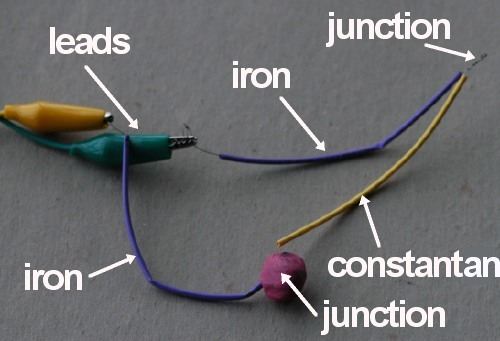
            <p>The <span class="caps">ITSI</span> kit contains two strands of very thin wire for making thermocouples. One wire is made of iron and the other of Constantan, a copper-nickel alloy. The iron wire looks faintly red due to rust, while the constantan is shiny.</p>
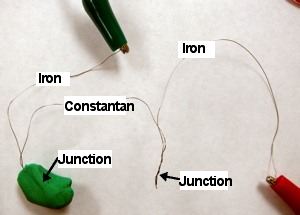
            <p>Suppose you made a circuit of first iron, then constantan, then iron again. It would look like this. There are three wires and two junctions. A lump of clay has been put around one of the two junctions. <br />
            <img src="http://itsi.concord.org/resources/images/00_circuits_sensors/thermocouple_labeled2.jpg" alt="" /></p>
            <p>If the two junctions are at the same temperature, the same voltage difference is generated in each but in the opposite direction. So the two voltages cancel out.</p>
            <p>But if the two junctions are at different temperatures, one will generate a larger voltage. Just like a stronger tug-of-war team can beat out the weaker, there will be a voltage difference that you can measure.</p>
            <p>Note that this sensor measures a <strong>difference</strong> in temperature, <strong>not its absolute value.</strong> For measuring change in temperature in a chemical reaction or comparing two temperatures, it is very fast and accurate.</p>
          </bodyText>
        </OTCompoundDoc>
        <OTCompoundDoc local_id='xhtml_5063'>
          <bodyText>
            <ul>
            	<li>GoLink</li>
            	<li>GoLink header</li>
            	<li>one 10 cm piece of constantan wire and 2 10 cm pieces of iron wire, OR</li>
            	<li>one 10 cm piece of iron wire and 2 10 cm pieces of constantan wire</li>
            	<li>wire insulation</li>
            	<li>2 clip leads</li>
            	<li>experiment board</li>
            	<li>circuit parts:
            	<ul>
            		<li>AD6523 I-amp</li>
            		<li>two 10K resistors, or nearby values (brown/black/orange)</li>
            		<li>one 100 ohm resistor (brown/black/brown)</li>
            		<li>short bits of wire</li>
            	</ul></li>
            </ul>
          </bodyText>
        </OTCompoundDoc>
        <OTCompoundDoc local_id='xhtml_5064'>
          <bodyText><p><strong>Important: Unplug your circuit from the computer each time you work on it.</strong> This is standard practice and you should make it a standard habit.</p></bodyText>
        </OTCompoundDoc>
        <OTCompoundDoc local_id='xhtml_5065'>
          <bodyText>
            <p><strong>The Experiment Board</strong></p>
            <p>If you are not familiar with how the experiment board works, go to <a href="http://itsidiy.concord.org/activities/579">this activity</a> for an introduction.</p>
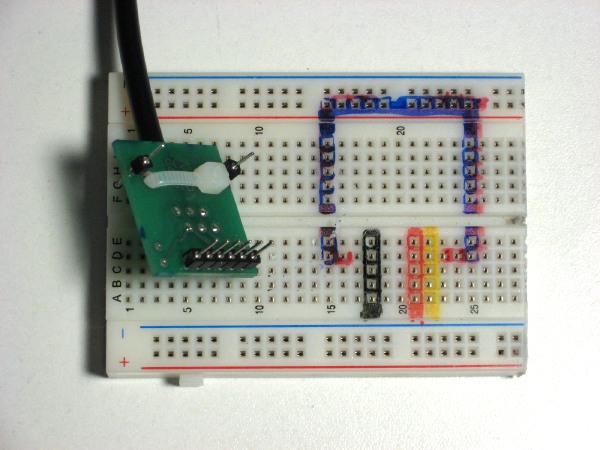
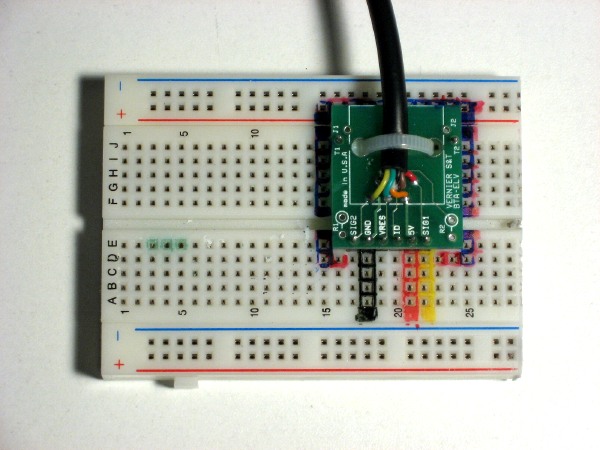
            <p>Plug the header into the experiment board so that each pin has its own row to connect wires to. If it helps, use colored markers to make it clear which is which. It is customary to use black for ground, red for +5V, and some other color for the signal.<br />
                         <br />
            <img src="http://itsi.concord.org/resources/images/00_circuits_sensors/header_and_bd.JPG" alt="" /></p>
            <p><img src="http://itsi.concord.org/resources/images/00_circuits_sensors/header_on_bd2.JPG" alt="" /></p>
            <p><strong>The Circuit</strong></p>
            <p><strong>Before beginning, disconnect the header from the GoLink.</strong></p>
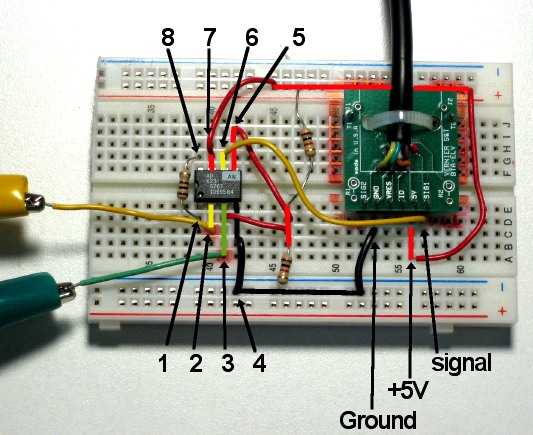
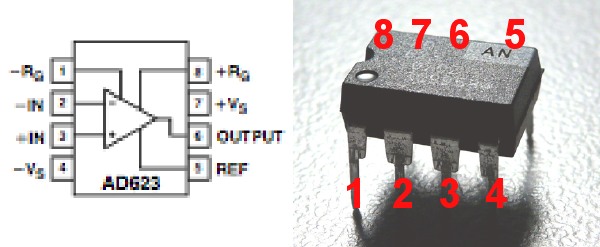
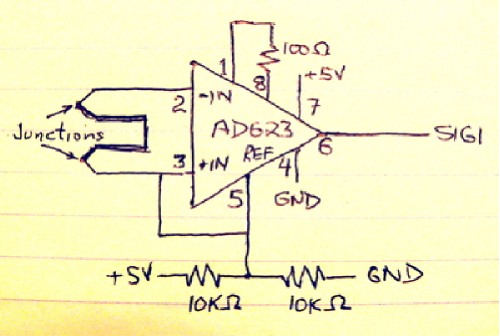
            <p>This circuit uses an amplifier which multiplies the signal from the thermocouple by 1000. This kind of amplifier is call an instrumentation amplified or &#8220;i-amp&#8221; for short. The amplifier pins are numbered from 1 to 8 counterclockwise, starting from the lower left corner. Pin 1 always has some sort of dot over it. <br />
            <img src="http://itsi.concord.org/resources/images/00_circuits_sensors/I-amp_labeled.jpg" alt="" /><br />
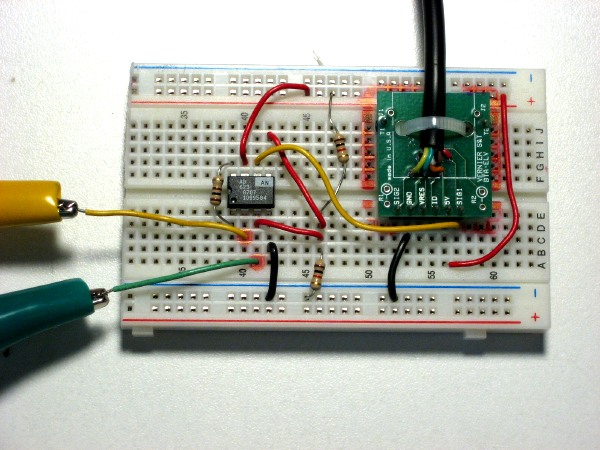
            Here is a picture of the circuit. <br />
            <img src="http://itsi.concord.org/resources/images/00_circuits_sensors/thermocouple_circuit4.jpg" alt="" /><br />
            Here are some labels and lines showing what wires are connected within the circuit board.<br />
            <img src="http://itsi.concord.org/resources/images/00_circuits_sensors/thermocouple_crct_labeled2.jpg" alt="" /><br />
            The circuit diagram looks like this. Note the pin numbers on the amplifier. <br />
            <img src="http://itsi.concord.org/resources/images/00_circuits_sensors/thermocouple_circuit_schematic.jpg" alt="" /></p>
            <p><strong>Build the thermocouple</strong></p>
            <ol>
            	<li>Cut two lengths of constantan and one of iron, all about 10 cm (4 inches) long.<br />
            <strong>Note</strong>: the order of metals does not matter. You can reverse the two metals and still get an equivalent thermocouple. It can be iron-constantan-iron <strong>or</strong> constantan-iron-constantan.</li>
            </ol>
            <ol>
            	<li>Get rid of oxidation on the last 1 cm of the wires by scraping with a knife or sandpaper. If possible, clean the ends with acid flux used by plumbers.</li>
            	<li>Twist the cleaned ends of one constantan and one iron wire together tightly using pliers. All metals form oxide coatings in air. It is essential to get the metals to touch and not only their oxide coatings. This can be done by squeezing, folding, and crushing the junction.<br />
            <strong>Note</strong>: If you are able to solder, solder the junctions using the acid flux and as little solder as possible. Soldering is optional but makes a better junction.</li>
            	<li>Slip the shrink tubing â€œspaghettiâ€ over the two thermocouple wires so that only the junction and the two ends are exposed.</li>
            	<li>Twist the other end of the iron (constantan) wire to the second constantan (iron) wire. This should make a constantan-iron-constantan (or iron-constantan-iron) thermocouple with two junctions.</li>
            	<li>Slip the shrink tubing â€œspaghettiâ€ over the bare wire so that only the two junctions and the ends are exposed. You now have a temperature difference sensor.<br />
            <img src="http://itsi.concord.org/resources/images/00_circuits_sensors/thermocouple_labeled.jpg" alt="" /></li>
            	<li>Bury one junction in a lump of clay. This keeps its temperature steady at about room temperature. The other junction can be used for measuring temperature changes.</li>
            	<li>Attach leads to the two iron ends that go back to the circuit.</li>
            </ol>
          </bodyText>
        </OTCompoundDoc>
        <OTCompoundDoc local_id='xhtml_5066'>
          <bodyText>
            <p>Test the circuit using the raw voltage measurement. Warm up one of the connections with your fingers. If it work backwards, reverse which is the measuring connection and which is the reference connection in the lump of clay.</p>
            <p>Remember that the calibration is relative, not absolute. A change of 52 mV (0.052 V) means a temperature <strong>difference</strong> of 1 degree C.</p>
          </bodyText>
        </OTCompoundDoc>
        <OTDataCollector autoScaleEnabled='false' displayButtons='0,1,2,3,4,5' local_id='data_collector_978' name='Raw Voltage Data Collector' showControlBar='true' title='Raw Voltage Data Collector' useDefaultToolBar='false'>
          <source>
            <OTDataGraphable color='255' connectPoints='true' drawMarks='false' lineWidth='2.0' name='Sensor' visible='true' xColumn='0'>
              <dataProducer>
                <OTSensorDataProxy local_id='data_proxy_data_collector_978' name='dataproducer'>
                  <request>
                    <OTExperimentRequest period='0.1'>
                      <sensorRequests>
                        <OTSensorRequest displayPrecision='-2' port='0' requiredMax='40.0' requiredMin='0.0' stepSize='0.01' type='23' unit='degC' />
                      </sensorRequests>
                    </OTExperimentRequest>
                  </request>
                </OTSensorDataProxy>
              </dataProducer>
              <dataStore>
                <OTDataStore local_id='data_store_data_collector_978' />
              </dataStore>
            </OTDataGraphable>
          </source>
          <xDataAxis>
            <OTDataAxis label='Time' labelFormat='None' max='30.0' min='0.0' units='s' />
          </xDataAxis>
          <yDataAxis>
            <OTDataAxis label='Raw Voltage' labelFormat='None' max='10.0' min='-1.0' units='V' />
          </yDataAxis>
        </OTDataCollector>
        <OTDataCollector autoScaleEnabled='false' displayButtons='0,1,2,3,4,5' local_id='data_collector_979' name='Raw Voltage Data Collector' showControlBar='true' title='Raw Voltage Data Collector' useDefaultToolBar='false'>
          <source>
            <OTDataGraphable color='255' connectPoints='true' drawMarks='false' lineWidth='2.0' name='Sensor' visible='true' xColumn='0'>
              <dataProducer>
                <OTSensorDataProxy local_id='data_proxy_data_collector_979' name='dataproducer'>
                  <request>
                    <OTExperimentRequest period='0.1'>
                      <sensorRequests>
                        <OTSensorRequest displayPrecision='-2' port='0' requiredMax='40.0' requiredMin='0.0' stepSize='0.01' type='23' unit='degC' />
                      </sensorRequests>
                    </OTExperimentRequest>
                  </request>
                </OTSensorDataProxy>
              </dataProducer>
              <dataStore>
                <OTDataStore local_id='data_store_data_collector_979' />
              </dataStore>
            </OTDataGraphable>
          </source>
          <xDataAxis>
            <OTDataAxis label='Time' labelFormat='None' max='30.0' min='0.0' units='s' />
          </xDataAxis>
          <yDataAxis>
            <OTDataAxis label='Raw Voltage' labelFormat='None' max='10.0' min='-1.0' units='V' />
          </yDataAxis>
        </OTDataCollector>
        <OTMenu local_id='menu_section_1370'>
          <cardContainer>
            <object refid='${page_card_container_section_1370}' />
          </cardContainer>
          <menuRule>
            <object refid='${page_rule_section_1370}' />
          </menuRule>
        </OTMenu>
        <OTMenuRule jumpToViewedCard='true' local_id='page_rule_section_1370' stepAhead='true' />
        <OTCompoundDoc local_id='xhtml_5054'>
          <bodyText>
            <p>In this activity, students measure relative humidity in the air using just a temperature sensor, by comparing the wet bulb and dry bulb temperatures.</p>
            <p><img src="http://itsi.concord.org/resources/images/04_Water_Cycle/humiditycartoon.jpg" alt="" /></p>
            <p><strong>How humid is it?</strong></p>
            <p>Some days it feels &#8220;dry&#8221; and some days it feels &#8220;muggy,&#8221; even though the temperature is the same. This is due to different amounts of water vapor in the air. Describe why you think humid air would feel different to us from dry air.</p>
            <p>There is always some water vapor in the air, but we can&#8217;t see it directly. How do you think one could measure it? Think of observable physical objects that might change if the air were more or less humid.</p>
            <p>Relative humidity is a measure of how much water is in the air. At any one temperature there is a maximum amount of water the air can carry. The relative humidity is a percent of this maximum. For example, when air holds all the moisture it can, the relative humidity is 100%. If more moisture is added, or if the temperature goes down, some moisture condenses out as liquid water droplets in the form of fog or mist.  When air holds only half the maximum amount of moisture, the relative humidity is 50%.</p>
            <p>There are several different ways to measure humidity. In this activity you will use a very simple and accurate technique, called the wet bulb &#8211;  dry bulb method. It depends on the fact that water cools when it evaporates. When the relative humidity is low, evaporation is rapid and there is lots of cooling. When the relative humidity is high, evaporation is slow and there is very little cooling. If the relative humidity is 100%, there is no cooling at all!</p>
            <p>The temperature of a dry temperature sensor and a wet temperature sensor are compared. The greater the difference, the lower the relative humidity.</p>
          </bodyText>
        </OTCompoundDoc>
        <OTQuestion local_id='open_response_1537'>
          <prompt>
            <OTCompoundDoc>
              <bodyText><p>Explain in your own words why you think the evaporation of water causes cooling.</p></bodyText>
            </OTCompoundDoc>
          </prompt>
          <input>
            <OTText columns='40' local_id='response_open_response_1537' rows='2'>
              <text>Place answer here!</text>
            </OTText>
          </input>
        </OTQuestion>
        <OTCompoundDoc local_id='xhtml_5055'>
          <bodyText>
            <p>This activity addresses <span class="caps">NSES</span> standards for earth and space science and inquiry at grades 5-8 for structure of the earth system <br />
            (<a href="http://books.nap.edu/readingroom/books/nses/6d.html#es">http://books.nap.edu/readingroom/books/nses/6d.html#es</a>).</p>
          </bodyText>
        </OTCompoundDoc>
        <OTCompoundDoc local_id='xhtml_5056'>
          <bodyText>
            <ul>
            	<li>Fast-response temperature sensor
            	<ul>
            		<li>See Data Collection Part 1 for commercial sensors</li>
            		<li>See Data Collection Part 2 for the <span class="caps">ITSI</span> Probe Kit thermocouple sensor</li>
            	</ul></li>
            	<li>Small piece of gauze (such as from a band-aid)</li>
            	<li>Cup of water</li>
            </ul>
          </bodyText>
        </OTCompoundDoc>
        <OTCompoundDoc local_id='xhtml_5057'>
          <bodyText><p>There are no special safety concerns in this activity.</p></bodyText>
        </OTCompoundDoc>
        <OTCompoundDoc local_id='xhtml_5058'>
          <bodyText>
            <ul>
            	<li>After you have done this activity once, you can use it as part of the other activities that require monitoring relative humidity. Skip directly to the Collect Data section and make your dry bulb â€“ wet bulb measurements.</li>
            	<li><strong>Note</strong>: If you need to make repeated relative humidity measurements, it may be easier to work with another team, using one temperature sensor for the dry bulb measurement and one for the wet bulb measurement.</li>
            </ul>
          </bodyText>
        </OTCompoundDoc>
        <OTCompoundDoc local_id='xhtml_5059'>
          <bodyText>
            <p><strong>Part 1: using a commercial temperature sensor</strong></p>
            <ol>
            	<li>Measure the air temperature with a dry temperature sensor. You can wave the sensor back and forth to be sure it reaches the temperature of the air.</li>
            	<li>Dry bulb temperature  =______.</li>
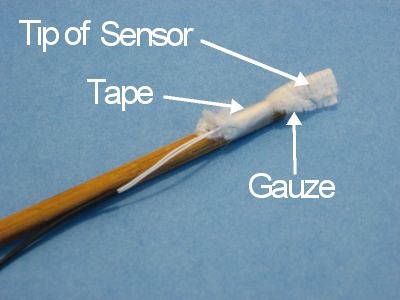
            	<li>Wrap gauze (bandage gauze is good) around the temperature sensor and hold it in place with a twist tie or a piece of tape. Be sure that the gauze around the sensor is fully exposed to the air. Attach it to a pencil or ruler so that you can wave it around and it won&#8217;t fall apart.<br />
            <img src="http://itsi.concord.org/resources/images/04_Water_Cycle/wetbulb.jpg" alt="" /></li>
            	<li>Dip the gauze in room-temperature water.</li>
            	<li>Start recording temperature.  Wave the sensor vigorously back and forth to create as much evaporation as possible. Note the lowest temperature the sensor reaches.  It may take a few minutes for the sensor to reach its lowest temperature. Dip the gauze into water and try again, to see if you can get the temperature even lower. You may repeat this several times and wave the sensor for several minutes before you reach the lowest possible temperature. <strong>Note</strong>: you can save several datasets by using the <strong>new</strong> button on the left.</li>
            	<li>Lowest (wet bulb) temperature =______.</li>
            	<li>Calculate the difference between the two measurements.</li>
            	<li>(Dry bulb) â€“ (Wet bulb) =_______.</li>
            	<li>Use the following chart to determine the relative humidity. The change in temperature (Dry bulb &#8211; wet bulb) is shown in red. <a href="http://www.novalynx.com/reference-rh-table.html" target="new">http://www.novalynx.com/reference-rh-table.html</a></li>
            </ol>
          </bodyText>
        </OTCompoundDoc>
        <OTDataCollector autoScaleEnabled='false' displayButtons='0,1,2,3,4,5' local_id='data_collector_976' name='Temperature Data Collector' showControlBar='true' title='Temperature Data Collector' useDefaultToolBar='false'>
          <source>
            <OTDataGraphable color='255' connectPoints='true' drawMarks='false' lineWidth='2.0' name='Sensor' visible='true' xColumn='0'>
              <dataProducer>
                <OTSensorDataProxy local_id='data_proxy_data_collector_976' name='dataproducer'>
                  <request>
                    <OTExperimentRequest period='0.1'>
                      <sensorRequests>
                        <OTSensorRequest displayPrecision='-1' port='0' requiredMax='40.0' requiredMin='0.0' stepSize='0.1' type='0' unit='degC' />
                      </sensorRequests>
                    </OTExperimentRequest>
                  </request>
                </OTSensorDataProxy>
              </dataProducer>
              <dataStore>
                <OTDataStore local_id='data_store_data_collector_976' />
              </dataStore>
            </OTDataGraphable>
          </source>
          <xDataAxis>
            <OTDataAxis label='Time' labelFormat='None' max='30.0' min='0.0' units='s' />
          </xDataAxis>
          <yDataAxis>
            <OTDataAxis label='Temperature' labelFormat='None' max='40.0' min='0.0' units='degC' />
          </yDataAxis>
        </OTDataCollector>
        <OTQuestion local_id='open_response_1538'>
          <prompt>
            <OTCompoundDoc>
              <bodyText><p>Relative humidity =____.</p></bodyText>
            </OTCompoundDoc>
          </prompt>
          <input>
            <OTText columns='40' local_id='response_open_response_1538' rows='2'>
              <text>Place answer here!</text>
            </OTText>
          </input>
        </OTQuestion>
        <OTDataCollector autoScaleEnabled='false' displayButtons='0,1,2,3,4,5' local_id='data_collector_977' name='Temperature Data Collector' showControlBar='true' title='Temperature Data Collector' useDefaultToolBar='false'>
          <source>
            <OTDataGraphable color='255' connectPoints='true' drawMarks='false' lineWidth='2.0' name='Sensor' visible='true' xColumn='0'>
              <dataProducer>
                <OTSensorDataProxy local_id='data_proxy_data_collector_977' name='dataproducer'>
                  <request>
                    <OTExperimentRequest period='0.1'>
                      <sensorRequests>
                        <OTSensorRequest displayPrecision='-1' port='0' requiredMax='40.0' requiredMin='0.0' stepSize='0.1' type='0' unit='degC' />
                      </sensorRequests>
                    </OTExperimentRequest>
                  </request>
                </OTSensorDataProxy>
              </dataProducer>
              <dataStore>
                <OTDataStore local_id='data_store_data_collector_977' />
              </dataStore>
            </OTDataGraphable>
          </source>
          <xDataAxis>
            <OTDataAxis label='Time' labelFormat='None' max='30.0' min='0.0' units='s' />
          </xDataAxis>
          <yDataAxis>
            <OTDataAxis label='Temperature' labelFormat='None' max='40.0' min='0.0' units='degC' />
          </yDataAxis>
        </OTDataCollector>
        <OTCompoundDoc local_id='xhtml_5060'>
          <bodyText>
            <ol>
            	<li>Measure several times. Do you get the same temperature values each time?</li>
            	<li>Compare your results to that of other student groups. Are they the same?</li>
            	<li>Why do you think it&#8217;s important to wave the wet bulb sensor back and forth?</li>
            	<li>Why do you think it&#8217;s not correct to blow on the wet bulb sensor to cause evaporation?</li>
            	<li>Why do you think the cooling effect of evaporation is greater for dry air than for humid air?</li>
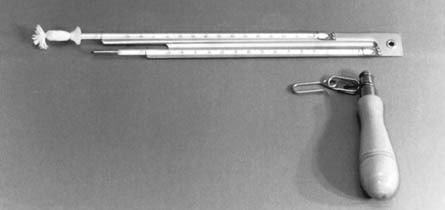
            	<li>Here is a picture of a commercial &#8220;sling psychrometer&#8221; that uses the same principle as your measurement. Explain what the parts are and how you think it works.<br />
            <img src="http://itsi.concord.org/resources/images/04_Water_Cycle/sling_psychrometer.jpg" alt="" /></li>
            </ol>
          </bodyText>
        </OTCompoundDoc>
        <OTCompoundDoc local_id='xhtml_5061'>
          <bodyText><p>Based on what you have observed, would sweating help cool you more in a desert, or in a rainforest? Why?</p></bodyText>
        </OTCompoundDoc>
        <OTMenu local_id='menu_section_1369'>
          <cardContainer>
            <object refid='${page_card_container_section_1369}' />
          </cardContainer>
          <menuRule>
            <object refid='${page_rule_section_1369}' />
          </menuRule>
        </OTMenu>
        <OTMenuRule jumpToViewedCard='true' local_id='page_rule_section_1369' stepAhead='true' />
        <OTCompoundDoc local_id='xhtml_5067'>
          <bodyText>
            <p>In this activity, students measure relative humidity in the air using just a temperature sensor, by comparing the wet bulb and dry bulb temperatures.</p>
            <p><img src="http://itsi.concord.org/resources/images/04_Water_Cycle/humiditycartoon.jpg" alt="" /></p>
            <p><strong>How humid is it?</strong></p>
            <p>Some days it feels &#8220;dry&#8221; and some days it feels &#8220;muggy,&#8221; even though the temperature is the same. This is due to different amounts of water vapor in the air. Describe why you think humid air would feel different to us from dry air.</p>
            <p>There is always some water vapor in the air, but we can&#8217;t see it directly. How do you think one could measure it? Think of observable physical objects that might change if the air were more or less humid.</p>
            <p>Relative humidity is a measure of how much water is in the air. At any one temperature there is a maximum amount of water the air can carry. The relative humidity is a percent of this maximum. For example, when air holds all the moisture it can, the relative humidity is 100%. If more moisture is added, or if the temperature goes down, some moisture condenses out as liquid water droplets in the form of fog or mist.  When air holds only half the maximum amount of moisture, the relative humidity is 50%.</p>
            <p>There are several different ways to measure humidity. In this activity you will use a very simple and accurate technique, called the wet bulb &#8211;  dry bulb method. It depends on the fact that water cools when it evaporates. When the relative humidity is low, evaporation is rapid and there is lots of cooling. When the relative humidity is high, evaporation is slow and there is very little cooling. If the relative humidity is 100%, there is no cooling at all!</p>
            <p>The temperature of a dry temperature sensor and a wet temperature sensor are compared. The greater the difference, the lower the relative humidity.</p>
          </bodyText>
        </OTCompoundDoc>
        <OTQuestion local_id='open_response_1539'>
          <prompt>
            <OTCompoundDoc>
              <bodyText><p>Explain in your own words why you think the evaporation of water causes cooling.</p></bodyText>
            </OTCompoundDoc>
          </prompt>
          <input>
            <OTText columns='40' local_id='response_open_response_1539' rows='2'>
              <text>Place answer here!</text>
            </OTText>
          </input>
        </OTQuestion>
        <OTCompoundDoc local_id='xhtml_5068'>
          <bodyText>
            <p>This activity addresses <span class="caps">NSES</span> standards for earth and space science and inquiry at grades 5-8 for structure of the earth system <br />
            (<a href="http://books.nap.edu/readingroom/books/nses/6d.html#es">http://books.nap.edu/readingroom/books/nses/6d.html#es</a>).</p>
          </bodyText>
        </OTCompoundDoc>
        <OTCompoundDoc local_id='xhtml_5069'>
          <bodyText>
            <ul>
            	<li>Fast-response temperature sensor. See:</li>
            	<li>temperature sensor: see
            	<ul>
            		<li><a href="http://itsidiy.concord.org/activities/392/sail_jnlp/6/13">Thermocouple &#8211; probe construction</a></li>
            	</ul></li>
            	<li><span class="caps">ITSI</span> Probe Kit thermocouple sensor</li>
            	<li>Small piece of gauze (such as from a band-aid)</li>
            	<li>Cup of water</li>
            </ul>
          </bodyText>
        </OTCompoundDoc>
        <OTCompoundDoc local_id='xhtml_5070'>
          <bodyText><p>There are no special safety concerns in this activity.</p></bodyText>
        </OTCompoundDoc>
        <OTCompoundDoc local_id='xhtml_5071'>
          <bodyText>
            <ul>
            	<li>After you have done this activity once, you can use it as part of the other activities that require monitoring relative humidity. Skip directly to the Collect Data section and make your dry bulb â€“ wet bulb measurements.</li>
            	<li><strong>Note</strong>: If you need to make repeated relative humidity measurements, it may be easier to work with another team, using one temperature sensor for the dry bulb measurement and one for the wet bulb measurement.</li>
            </ul>
          </bodyText>
        </OTCompoundDoc>
        <OTDataCollector autoScaleEnabled='false' displayButtons='0,1,2,3,4,5' local_id='data_collector_980' name='Temperature Data Collector' showControlBar='true' title='Temperature Data Collector' useDefaultToolBar='false'>
          <source>
            <OTDataGraphable color='255' connectPoints='true' drawMarks='false' lineWidth='2.0' name='Sensor' visible='true' xColumn='0'>
              <dataProducer>
                <OTSensorDataProxy local_id='data_proxy_data_collector_980' name='dataproducer'>
                  <request>
                    <OTExperimentRequest period='0.1'>
                      <sensorRequests>
                        <OTSensorRequest displayPrecision='-1' port='0' requiredMax='40.0' requiredMin='0.0' stepSize='0.1' type='0' unit='degC' />
                      </sensorRequests>
                    </OTExperimentRequest>
                  </request>
                </OTSensorDataProxy>
              </dataProducer>
              <dataStore>
                <OTDataStore local_id='data_store_data_collector_980' />
              </dataStore>
            </OTDataGraphable>
          </source>
          <xDataAxis>
            <OTDataAxis label='Time' labelFormat='None' max='30.0' min='0.0' units='s' />
          </xDataAxis>
          <yDataAxis>
            <OTDataAxis label='Temperature' labelFormat='None' max='40.0' min='0.0' units='degC' />
          </yDataAxis>
        </OTDataCollector>
        <OTCompoundDoc local_id='xhtml_5072'>
          <bodyText>
            <ol>
            	<li>Measure several times. Do you get the same temperature values each time?</li>
            	<li>Compare your results to that of other student groups. Are they the same?</li>
            	<li>Why do you think it&#8217;s important to wave the wet bulb sensor back and forth?</li>
            	<li>Why do you think it&#8217;s not correct to blow on the wet bulb sensor to cause evaporation?</li>
            	<li>Why do you think the cooling effect of evaporation is greater for dry air than for humid air?</li>
            	<li>Here is a picture of a commercial &#8220;sling psychrometer&#8221; that uses the same principle as your measurement. Explain what the parts are and how you think it works.<br />
            <img src="http://itsi.concord.org/resources/images/04_Water_Cycle/sling_psychrometer.jpg" alt="" /></li>
            </ol>
          </bodyText>
        </OTCompoundDoc>
        <OTCompoundDoc local_id='xhtml_5073'>
          <bodyText><p>Based on what you have observed, would sweating help cool you more in a desert, or in a rainforest? Why?</p></bodyText>
        </OTCompoundDoc>
        <OTMenu local_id='menu_section_1371'>
          <cardContainer>
            <object refid='${page_card_container_section_1371}' />
          </cardContainer>
          <menuRule>
            <object refid='${page_rule_section_1371}' />
          </menuRule>
        </OTMenu>
        <OTMenuRule jumpToViewedCard='true' local_id='page_rule_section_1371' stepAhead='true' />
        <OTCompoundDoc local_id='xhtml_5074'>
          <bodyText>
            <p>This activity shows how to build a circuit to measure relative humidity using a <span class="caps">TDK</span> precalibrated sensor. Note: This sensor costs about $25 and is <strong>not</strong> included in the <span class="caps">ITSI</span> probe kit. It can be ordered from digikey.com, <span class="caps">TDK</span> part # <span class="caps">CHS</span>-<span class="caps">MSS</span>.</p>
            <p><strong>How the <span class="caps">TDK</span> relative humidity sensor works</strong></p>
            <p>This sensor has an internal integrated circuit that converts a change in capacitance (caused by the change in relative humidity of the air) into an output voltage. It has two features that make it <strong>very</strong> easy to use:</p>
            <ul>
            	<li>The three pins are labeled, so you know exactly how to connect them.</li>
            	<li>The output voltage is equal to the relative humidity. That is, an output of .56 V means the relative humidity is 56%.</li>
            </ul>
          </bodyText>
        </OTCompoundDoc>
        <OTCompoundDoc local_id='xhtml_5075'>
          <bodyText>
            <ul>
            	<li>experiment board</li>
            	<li>GoLink</li>
            	<li>GoLink header</li>
            	<li>circuit parts:
            	<ul>
            		<li><span class="caps">TDK</span> relative humidity sensor (<span class="caps">CHS</span>-<span class="caps">MSS</span>, from digikey.com)</li>
            		<li>short bits of wire</li>
            	</ul></li>
            </ul>
          </bodyText>
        </OTCompoundDoc>
        <OTCompoundDoc local_id='xhtml_5076'>
          <bodyText>
            <p><strong>The Experiment Board</strong></p>
            <p>If you are not familiar with how the experiment board works, go to <a href="http://itsidiy.concord.org/activities/579">this activity</a> for an introduction.</p>
            <p>Plug the header into the experiment board so that each pin has its own row to connect wires to. If it helps, use colored markers to make it clear which is which. It is customary to use black for ground, red for +5V, and some other color for the signal.<br />
                         <br />
            <img src="http://itsi.concord.org/resources/images/00_circuits_sensors/header_and_bd.JPG" alt="" /></p>
            <p><img src="http://itsi.concord.org/resources/images/00_circuits_sensors/header_on_bd2.JPG" alt="" /></p>
            <p><strong>The Circuit</strong></p>
            <p><strong>Before beginning, disconnect the header from the GoLink.</strong></p>
            <p>Make the following connections:</p>
            
            	<ul>
            		<li>G = ground</li>
            		<li>+5  = +5 V</li>
            		<li>Vout =  signal</li>
            	</ul><p>The resulting circuit should look like this picture.<br />
             <br />
            <img src="http://itsi.concord.org/resources/images/00_circuits_sensors/RH_TDK_sensor_circuit.jpg" alt="" /></p>
            <p>Note that you could build an &#8220;extension cord&#8221;, as shown with the TMP36 temperature sensor, by using a small piece of breadboard for the <span class="caps">TDK</span> sensor and connecting it back to the header with long wires.</p>
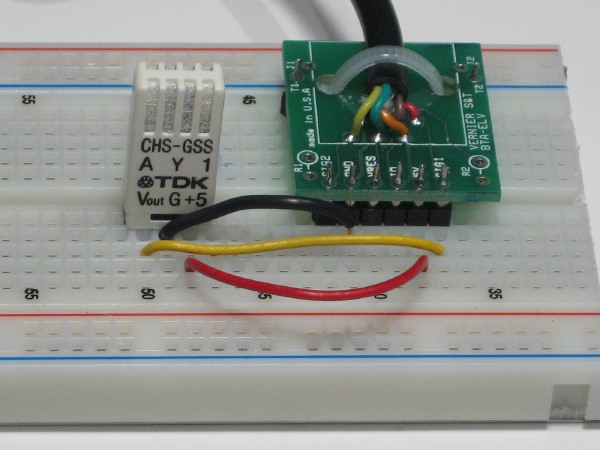
            <p>To check the circuit, breathe on the sensor. It should shoot up!</p>
          </bodyText>
        </OTCompoundDoc>
        <OTCompoundDoc local_id='xhtml_5077'>
          <bodyText><p>Test the circuit using the raw voltage measurement. The voltage output is equal to the relative humidity. For example, .75 V equals 75% relative humidity.</p></bodyText>
        </OTCompoundDoc>
        <OTDataCollector autoScaleEnabled='false' displayButtons='0,1,2,3,4,5' local_id='data_collector_981' name='Raw Voltage Data Collector' showControlBar='true' title='Raw Voltage Data Collector' useDefaultToolBar='false'>
          <source>
            <OTDataGraphable color='255' connectPoints='true' drawMarks='false' lineWidth='2.0' name='Sensor' visible='true' xColumn='0'>
              <dataProducer>
                <OTSensorDataProxy local_id='data_proxy_data_collector_981' name='dataproducer'>
                  <request>
                    <OTExperimentRequest period='0.1'>
                      <sensorRequests>
                        <OTSensorRequest displayPrecision='-2' port='0' requiredMax='40.0' requiredMin='0.0' stepSize='0.01' type='23' unit='degC' />
                      </sensorRequests>
                    </OTExperimentRequest>
                  </request>
                </OTSensorDataProxy>
              </dataProducer>
              <dataStore>
                <OTDataStore local_id='data_store_data_collector_981' />
              </dataStore>
            </OTDataGraphable>
          </source>
          <xDataAxis>
            <OTDataAxis label='Time' labelFormat='None' max='30.0' min='0.0' units='s' />
          </xDataAxis>
          <yDataAxis>
            <OTDataAxis label='Raw Voltage' labelFormat='None' max='10.0' min='-1.0' units='V' />
          </yDataAxis>
        </OTDataCollector>
        <OTMenu local_id='menu_section_1372'>
          <cardContainer>
            <object refid='${page_card_container_section_1372}' />
          </cardContainer>
          <menuRule>
            <object refid='${page_rule_section_1372}' />
          </menuRule>
        </OTMenu>
        <OTMenuRule jumpToViewedCard='true' local_id='page_rule_section_1372' stepAhead='true' />
        <OTCompoundDoc local_id='xhtml_5078'>
          <bodyText>
            <p>In this activity, students use a relative humidity sensor and a soda bottle to measure humidity near surfaces, such as over a leaf or above an ice cube.</p>
            <p><img src="http://itsi.concord.org/resources/images/04_Water_Cycle/humiditycartoon.jpg" alt="" /></p>
            <p><strong>Where does humidity come  from?</strong></p>
            <p>There is always some water vapor in the air. We can&#8217;t see it directly, but we can measure its presence with a <strong>relative humidity sensor</strong>.</p>
            <p>Relative humidity is a measure of how much water is in the air. At any one temperature there is a maximum amount of water the air can carry. The relative humidity is a percent of this maximum. For example, when air holds all the moisture it can, the relative humidity is 100%. If more moisture is added, or if the temperature goes down, some moisture condenses out as liquid water droplets in the form of fog or mist.  When air holds only half the maximum amount of moisture, the relative humidity is 50%. <strong>Relative humidity is the amount of moisture in the air relative to the maximum it can hold</strong>.</p>
            <p>Warmer air holds more moisture than colder air. So relative humidity is affected by <strong>both</strong> temperature and moisture content. For instance, you can raise relative humidity <strong>either</strong> by adding water vapor to the air <strong>or</strong> by lowering the temperature.</p>
            <p>What are two ways to <strong>lower</strong> relative humidity? <br />
             <br />
            Picture a natural landscape that you know well &#8212; your back yard, a special place you go in summer. Picture it in a certain season, at a certain time of day. You can draw it if you wish with the draw tool below.</p>
          </bodyText>
        </OTCompoundDoc>
        <OTQuestion local_id='open_response_1540'>
          <prompt>
            <OTCompoundDoc>
              <bodyText><p>The relative humidity won&#8217;t be the same everywhere in this picture. Where will it be higher? Where will it be lower? Why?</p></bodyText>
            </OTCompoundDoc>
          </prompt>
          <input>
            <OTText columns='40' local_id='response_open_response_1540' rows='2'>
              <text>Place answer here!</text>
            </OTText>
          </input>
        </OTQuestion>
        <OTQuestion local_id='open_response_1541'>
          <prompt>
            <OTCompoundDoc>
              <bodyText><p>The relative humidity won&#8217;t be the same everywhere in this picture. Where will it be higher? Where will it be lower? Why?</p></bodyText>
            </OTCompoundDoc>
          </prompt>
          <input>
            <OTText columns='40' local_id='response_open_response_1541' rows='2'>
              <text>Still to be implemented: later this will be a Drawing instead of an Open Response question ...</text>
            </OTText>
          </input>
        </OTQuestion>
        <OTCompoundDoc local_id='xhtml_5079'>
          <bodyText>
            <ul>
            	<li>relative humidity (RH) sensor, wand type
            	<ul>
            		<li>Other types of relative humidity sensors may be used, with adaptations.</li>
            	</ul></li>
            	<li>1 liter soda bottle</li>
            	<li>scissors</li>
            	<li>modeling clay</li>
            	<li>ice cubes</li>
            	<li>aluminum foil</li>
            	<li>shallow bowls</li>
            	<li>other materials to test: green leaves, soil, sand, etc.</li>
            	<li>temperature sensor (optional)</li>
            </ul>
          </bodyText>
        </OTCompoundDoc>
        <OTCompoundDoc local_id='xhtml_5080'>
          <bodyText><p>There are no special safety concerns in this activity.</p></bodyText>
        </OTCompoundDoc>
        <OTCompoundDoc local_id='xhtml_5081'>
          <bodyText>
            <ol>
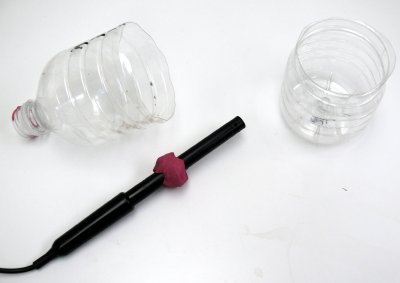
            	<li>Cut the bottom off of a soda bottle, about 1/3 of the way from the bottom. <br />
            <img src="http://itsi.concord.org/resources/images/04_Water_Cycle/RHsensor_cut_bottle.jpg" alt="" /></li>
            	<li>Wrap the RH sensor with a finger-thick tube of clay.</li>
            	<li>Install the RH sensor through the top of the bottle, using the clay to hold it in place.<br />
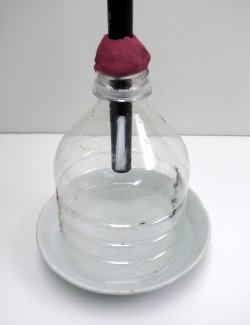
            <img src="http://itsi.concord.org/resources/images/04_Water_Cycle/RHsensor_in_bottle.jpg" alt="" /></li>
            	<li>You now have a relative humidity tester that can measure how much moisture is put into the air by different surfaces.</li>
            </ol>
          </bodyText>
        </OTCompoundDoc>
        <OTCompoundDoc local_id='xhtml_5082'>
          <bodyText>
            <p>Think of several micro-environments you would like to test. Here are some examples, but you can also invent your own.</p>
            <ul>
            	<li>cold water in a dish</li>
            	<li>hot water in a dish</li>
            	<li>ice cubes in a dish</li>
            	<li>ice cubes covered with aluminum foil (so that the ice surface is not exposed)</li>
            	<li>snow</li>
            	<li>the palm of your hand</li>
            	<li>under a bright, hot light bulb</li>
            	<li>green leaves</li>
            	<li>brown leaves</li>
            	<li>soil rich in humus</li>
            	<li>sand</li>
            	<li>a moisture-absorbing desiccant, such as calcium chloride</li>
            </ul>
            <p>Study your list. Which surface will raise the relative humidity compared to the air, and which will lower it?</p>
          </bodyText>
        </OTCompoundDoc>
        <OTCompoundDoc local_id='xhtml_5083'>
          <bodyText><p>Measure the relative humidity of the air, with nothing closing off the sensor. Then pick several surfaces and test them. You can make a new dataset for each material, or test them one after the other and label the graph.</p></bodyText>
        </OTCompoundDoc>
        <OTDataCollector autoScaleEnabled='false' displayButtons='0,1,2,3,4,5' local_id='data_collector_982' name='Relative Humidity Data Collector' showControlBar='true' title='Relative Humidity Data Collector' useDefaultToolBar='false'>
          <source>
            <OTDataGraphable color='255' connectPoints='true' drawMarks='false' lineWidth='2.0' name='Sensor' visible='true' xColumn='0'>
              <dataProducer>
                <OTSensorDataProxy local_id='data_proxy_data_collector_982' name='dataproducer'>
                  <request>
                    <OTExperimentRequest period='0.1'>
                      <sensorRequests>
                        <OTSensorRequest displayPrecision='-1' port='0' requiredMax='40.0' requiredMin='0.0' stepSize='0.1' type='7' unit='degC' />
                      </sensorRequests>
                    </OTExperimentRequest>
                  </request>
                </OTSensorDataProxy>
              </dataProducer>
              <dataStore>
                <OTDataStore local_id='data_store_data_collector_982' />
              </dataStore>
            </OTDataGraphable>
          </source>
          <xDataAxis>
            <OTDataAxis label='Time' labelFormat='None' max='30.0' min='0.0' units='s' />
          </xDataAxis>
          <yDataAxis>
            <OTDataAxis label='Relative Humidity' labelFormat='None' max='90.0' min='10.0' units='percentage' />
          </yDataAxis>
        </OTDataCollector>
        <OTQuestion local_id='open_response_1542'>
          <prompt>
            <OTCompoundDoc>
              <bodyText><p>Use the text box to take notes about what you tried.</p></bodyText>
            </OTCompoundDoc>
          </prompt>
          <input>
            <OTText columns='40' local_id='response_open_response_1542' rows='2'>
              <text>Place answer here!</text>
            </OTText>
          </input>
        </OTQuestion>
        <OTDataCollector autoScaleEnabled='false' displayButtons='0,1,2,3,4,5' local_id='data_collector_983' name='Relative Humidity Data Collector' showControlBar='true' title='Relative Humidity Data Collector' useDefaultToolBar='false'>
          <source>
            <OTDataGraphable color='255' connectPoints='true' drawMarks='false' lineWidth='2.0' name='Sensor' visible='true' xColumn='0'>
              <dataProducer>
                <OTSensorDataProxy local_id='data_proxy_data_collector_983' name='dataproducer'>
                  <request>
                    <OTExperimentRequest period='0.1'>
                      <sensorRequests>
                        <OTSensorRequest displayPrecision='-1' port='0' requiredMax='40.0' requiredMin='0.0' stepSize='0.1' type='7' unit='degC' />
                      </sensorRequests>
                    </OTExperimentRequest>
                  </request>
                </OTSensorDataProxy>
              </dataProducer>
              <dataStore>
                <OTDataStore local_id='data_store_data_collector_983' />
              </dataStore>
            </OTDataGraphable>
          </source>
          <xDataAxis>
            <OTDataAxis label='Time' labelFormat='None' max='30.0' min='0.0' units='s' />
          </xDataAxis>
          <yDataAxis>
            <OTDataAxis label='Relative Humidity' labelFormat='None' max='90.0' min='10.0' units='percentage' />
          </yDataAxis>
        </OTDataCollector>
        <OTQuestion local_id='open_response_1543'>
          <prompt>
            <OTCompoundDoc>
              <bodyText><p>Use the text box to take notes about what you tried.</p></bodyText>
            </OTCompoundDoc>
          </prompt>
          <input>
            <OTText columns='40' local_id='response_open_response_1543' rows='2'>
              <text>Place answer here!</text>
            </OTText>
          </input>
        </OTQuestion>
        <OTDataCollector autoScaleEnabled='false' displayButtons='0,1,2,3,4,5' local_id='data_collector_984' name='Relative Humidity Data Collector' showControlBar='true' title='Relative Humidity Data Collector' useDefaultToolBar='false'>
          <source>
            <OTDataGraphable color='255' connectPoints='true' drawMarks='false' lineWidth='2.0' name='Sensor' visible='true' xColumn='0'>
              <dataProducer>
                <OTSensorDataProxy local_id='data_proxy_data_collector_984' name='dataproducer'>
                  <request>
                    <OTExperimentRequest period='0.1'>
                      <sensorRequests>
                        <OTSensorRequest displayPrecision='-1' port='0' requiredMax='40.0' requiredMin='0.0' stepSize='0.1' type='7' unit='degC' />
                      </sensorRequests>
                    </OTExperimentRequest>
                  </request>
                </OTSensorDataProxy>
              </dataProducer>
              <dataStore>
                <OTDataStore local_id='data_store_data_collector_984' />
              </dataStore>
            </OTDataGraphable>
          </source>
          <xDataAxis>
            <OTDataAxis label='Time' labelFormat='None' max='30.0' min='0.0' units='s' />
          </xDataAxis>
          <yDataAxis>
            <OTDataAxis label='Relative Humidity' labelFormat='None' max='90.0' min='10.0' units='percentage' />
          </yDataAxis>
        </OTDataCollector>
        <OTQuestion local_id='open_response_1544'>
          <prompt>
            <OTCompoundDoc>
              <bodyText><p>Often the RH will change due to a change in temperature. If you have a temperature sensor, you can check to see if the temperature change may have caused the observed change in RH.</p></bodyText>
            </OTCompoundDoc>
          </prompt>
          <input>
            <OTText columns='40' local_id='response_open_response_1544' rows='2'>
              <text>Place answer here!</text>
            </OTText>
          </input>
        </OTQuestion>
        <OTCompoundDoc local_id='xhtml_5084'>
          <bodyText>
            <p>1. Did your measurements match your predictions?</p>
            <p>2. Were there surprises in your results?</p>
            <p>3. In each case, was the RH change due to a change in moisture, or a change in temperature?</p>
          </bodyText>
        </OTCompoundDoc>
        <OTCompoundDoc local_id='xhtml_5085'>
          <bodyText>
            <p>Recall the natural environment that you pictured. Based on your observations, where the RH be high and where would it be low?</p>
            <p>Think of some examples where organisms have adapted to and made use of the differences in micro-environments in nature. For example, where does mold grow? Why?</p>
          </bodyText>
        </OTCompoundDoc>
        <OTMenu local_id='menu_section_1373'>
          <cardContainer>
            <object refid='${page_card_container_section_1373}' />
          </cardContainer>
          <menuRule>
            <object refid='${page_rule_section_1373}' />
          </menuRule>
        </OTMenu>
        <OTMenuRule jumpToViewedCard='true' local_id='page_rule_section_1373' stepAhead='true' />
        <OTCompoundDoc local_id='xhtml_5086'>
          <bodyText>
            <p>In this investigation you will figure out the dew point temperature for your classroom.</p>
            <p><strong>At what temperature in your classroom would it start to rain?</strong></p>
            <p><img src="http://itsi.concord.org/artwork/Teemss2_images/Units/u14_i02/cartoon/u14_i02_web_cartoon.png" alt="" /></p>
            <p>A relative humidity measurement gives a measure of the amount of water in the air as compared with the maximum amount of water the air could hold without condensing out as fog. For example, a relative humidity reading of 35% means that the air is holding 35% of the water it could hold for that air temperature.</p>
          </bodyText>
        </OTCompoundDoc>
        <OTQuestion local_id='open_response_1545'>
          <prompt>
            <OTCompoundDoc>
              <bodyText><p>What happens when the relative humidity is 100%?</p></bodyText>
            </OTCompoundDoc>
          </prompt>
          <input>
            <OTText columns='40' local_id='response_open_response_1545' rows='2'>
              <text>Place answer here!</text>
            </OTText>
          </input>
        </OTQuestion>
        <OTCompoundDoc local_id='xhtml_5087'>
          <bodyText>
            <p>This activity addresses <span class="caps">NSES</span> standards for earth and space science and inquiry at grades 5-8 for structure of the earth system <br />
            (<a href="http://books.nap.edu/readingroom/books/nses/6d.html#es">http://books.nap.edu/readingroom/books/nses/6d.html#es</a>).</p>
          </bodyText>
        </OTCompoundDoc>
        <OTCompoundDoc local_id='xhtml_5088'>
          <bodyText>
            <ul>
            	<li>1 <a href="http://webapps.teemss2.concord.org/teemss2-teacher/vernier_gotemp_golink/technical_hint_id_22.html">temperature sensor</a></li>
            	<li>1 <a href="http://webapps.teemss2.concord.org/teemss2-teacher/vernier_gotemp_golink/technical_hint_id_28.html">relative humidity sensor</a><br />
            <strong>Note</strong>: if a relative humidity sensor is not available,  refer to the <strong>Relative Humidity Measurement</strong> activity, which explains how to use the temperature sensor to measure relative humidity.</li>
            </ul>
          </bodyText>
        </OTCompoundDoc>
        <OTCompoundDoc local_id='xhtml_5089'>
          <bodyText><p>There are no special safety concerns in this investigation.</p></bodyText>
        </OTCompoundDoc>
        <OTCompoundDoc local_id='xhtml_5090'>
          <bodyText>
            <p>1. Water is present in the air all around the earth, but the amount of water in the air varies according to the climate and other factors. The following table shows the historical average afternoon relative humidity and temperature for several locations in the United States during the month of June. (Data from <a href="http://ggweather.com/ccd/avgrh.htm">RH table</a>, <a href="http://ggweather.com/ccd/meantemp.htm">temperature chart</a>. Temperatures converted from F to C.)</p>
            <table style="width: 500px; border:2px black; background: silver; padding: 3px;">
            	<tr style="background: white;">
            		<th>City </th>
            		<th>Average RH (%) </th>
            		<th>Average Temp (Celsius)</th>
            	</tr>
            	<tr style="background: white;">
            		<td>New York, NY</td>
            		<td> 56%</td>
            		<td> 21.7</td>
            	</tr>
            	<tr style="background: white;">
            		<td>Las Vegas, NV</td>
            		<td> 11%</td>
            		<td> 29.7</td>
            	</tr>
            	<tr style="background: white;">
            		<td>Mt Washington, NH</td>
            		<td> 86%</td>
            		<td> 6.8</td>
            	</tr>
            	<tr style="background: white;">
            		<td>Los Angeles, CA</td>
            		<td> 68%</td>
            		<td> 19.1</td>
            	</tr>
            </table>
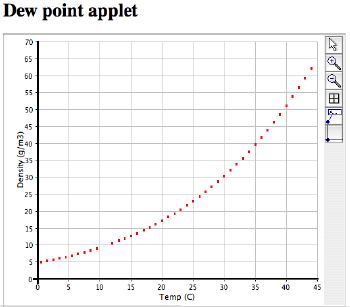
            <p>2. Using the Water Density Chart, calculate how much water is in the air in each of the locations of the chart. You can use the Ruler Tool to read values on the graph. Remember that the line represents that water density at 100% RH for a given temperature. Figure out how to use the Ruler Tool to find the water density at other values of relative humidity.  See <a href="http://webapps.teemss2.concord.org/teemss2-teacher/vernier_gotemp_golink/technical_hint_id_57.html">Technical Hints</a> for using the Ruler Tool.<br />
            <img src="http://itsi.concord.org/resources/images/04_Water_Cycle/dewpointapplet.jpg" alt="" /></p>
            <p>New York, NY, Avg. RH = 56%, Avg. Temp = 21.7 degrees C</p>
            <p>Water density (g/m3) =</p>
            <p>Las Vegas, NV, Avg. RH = 11%, Avg. Temp = 29.7 degrees C</p>
            <p>Water density (g/m3) =</p>
            <p>Mt Washington, NH, Avg. RH = 86%, Avg. Temp = 6.8 degrees C</p>
            <p>Water density (g/m3) =</p>
            <p>Los Angeles, CA, Avg. RH = 68%, Avg. Temp = 19.1 degrees C</p>
            <p>Water density (g/m3) =</p>
            <p>3. Based on your calculations, answer the following questions.</p>
            <p>Location with the highest temperature:</p>
            <p>Location with the highest relative humidity:</p>
            <p>Location with the highest water density:</p>
          </bodyText>
        </OTCompoundDoc>
        <OTQuestion local_id='open_response_1546'>
          <prompt>
            <OTCompoundDoc>
              <bodyText><p>4. Explain what geographic or other features might lead to these differences.</p></bodyText>
            </OTCompoundDoc>
          </prompt>
          <input>
            <OTText columns='40' local_id='response_open_response_1546' rows='2'>
              <text>Place answer here!</text>
            </OTText>
          </input>
        </OTQuestion>
        <OTCompoundDoc local_id='xhtml_5091'>
          <bodyText>
            <p>1. Your classroom air and the outside air all contain water. You&#8217;ve seen some situations where water comes out of the air. The reason water comes out of the air has to do with the dew point temperature, which we will now investigate more closely. Measure the temperature and relative humidity in your classroom. Refer to <a href="http://webapps.teemss2.concord.org/teemss2-teacher/vernier_gotemp_golink/technical_hint_id_2.html">Technical Hints</a> to connect the temperature sensor. Refer to <a href="http://webapps.teemss2.concord.org/teemss2-teacher/vernier_gotemp_golink/technical_hint_id_6.html">Technical Hints</a> to record a single measurement. Refer To the <strong>Relative Humidity Measurement</strong> activity to take the relative humidity measurement.</p>
            <p>Classroom temperature (deg C) =</p>
            <p>Classroom relative humidity (%) =</p>
            <p>2. Using the water density graph, you can figure out the <strong>dew point temperature</strong>. Use the Labeling Tool to mark the point on the graph corresponding to your classroom temperature. Refer to <a href="http://webapps.teemss2.concord.org/teemss2-teacher/vernier_gotemp_golink/technical_hint_id_48.html">Technical Hints</a> to label a point on the graph.<br />
            <img src="http://itsi.concord.org/resources/images/04_Water_Cycle/dewpointapplet.jpg" alt="" /><br />
            3. This point represents the <strong>most</strong> water the air in your classroom could hold (100% relative humidity for your classroom temperature). However, your classroom&#8217;s relative humidity is not 100%. It is something less than that. (If it were 100% in your classroom, it would be raining inside the room or the room would be filled with fog.) Using the Ruler Tool, mark the point on the graph that represents your actual classroom air temperature and water density. Refer to <a href="http://webapps.teemss2.concord.org/teemss2-teacher/vernier_gotemp_golink/technical_hint_id_57.html">Technical Hints</a> to use the Ruler Tool.</p>
            <p>4. At what temperature would your classroom relative humidity be 100%? This is the dew point temperature. To figure this out, follow the horizontal line from your Ruler Tool mark, and see where it crosses the water density graph. Use the Labeling Tool to label this point. The temperature at this point is your classroom dew point temperature. Fill in this temperature below.</p>
            <p>Classroom dew point temperature (deg C) =</p>
          </bodyText>
        </OTCompoundDoc>
        <OTDataCollector autoScaleEnabled='false' displayButtons='0,1,2,3,4,5' local_id='data_collector_985' name='Temperature Data Collector' showControlBar='true' title='Temperature Data Collector' useDefaultToolBar='false'>
          <source>
            <OTDataGraphable color='255' connectPoints='true' drawMarks='false' lineWidth='2.0' name='Sensor' visible='true' xColumn='0'>
              <dataProducer>
                <OTSensorDataProxy local_id='data_proxy_data_collector_985' name='dataproducer'>
                  <request>
                    <OTExperimentRequest period='0.1'>
                      <sensorRequests>
                        <OTSensorRequest displayPrecision='-1' port='0' requiredMax='40.0' requiredMin='0.0' stepSize='0.1' type='0' unit='degC' />
                      </sensorRequests>
                    </OTExperimentRequest>
                  </request>
                </OTSensorDataProxy>
              </dataProducer>
              <dataStore>
                <OTDataStore local_id='data_store_data_collector_985' />
              </dataStore>
            </OTDataGraphable>
          </source>
          <xDataAxis>
            <OTDataAxis label='Time' labelFormat='None' max='30.0' min='0.0' units='s' />
          </xDataAxis>
          <yDataAxis>
            <OTDataAxis label='Temperature' labelFormat='None' max='40.0' min='0.0' units='degC' />
          </yDataAxis>
        </OTDataCollector>
        <OTQuestion local_id='open_response_1547'>
          <prompt>
            <OTCompoundDoc>
              <bodyText><p>5. If the temperature in your classroom dropped to the dew point temperature, what would happen?</p></bodyText>
            </OTCompoundDoc>
          </prompt>
          <input>
            <OTText columns='40' local_id='response_open_response_1547' rows='2'>
              <text>Place answer here!</text>
            </OTText>
          </input>
        </OTQuestion>
        <OTCompoundDoc local_id='xhtml_5092'>
          <bodyText>
            <p>Using the water density graph below, answer the following question. You can use the Ruler Tool to read values on the graph. See <a href="http://webapps.teemss2.concord.org/teemss2-teacher/vernier_gotemp_golink/technical_hint_id_57.html">Technical Hints</a> for using the Ruler Tool.<br />
            <img src="http://itsi.concord.org/resources/images/04_Water_Cycle/dewpointapplet.jpg" alt="" /><br />
            Which sample of air contains the most water?</p>
            <ul>
            	<li>A. Air at 10 degrees Celsius with a relative humidity of 60%</li>
            	<li>B. Air at 15 degrees Celsius with a relative humidity of 90%</li>
            	<li>C. Air at 30 degrees Celsius with a relative humidity of 55%</li>
            </ul>
          </bodyText>
        </OTCompoundDoc>
        <OTCompoundDoc local_id='xhtml_5093'>
          <bodyText><p>Can the dew point ever be higher than the current air temperature? Explain.</p></bodyText>
        </OTCompoundDoc>
        <OTCompoundDoc local_id='xhtml_5094'>
          <bodyText>
            <ul>
            	<li>Evaporation is one way in which water goes into the air. Transpiration &#8211; plants giving off water &#8211; is another. Research the process of transpiration. How much of the water in the earth&#8217;s atmosphere is a result of transpiration? How much water does an average tree transpire into the air per day?</li>
            	<li>Track temperatures, dew points, humidity levels, and weather patterns in your local area over several months. What weather patterns are associated with high or low humidity?<br />
            (<a href="http://www.weather.gov/">http://www.weather.gov/</a>)</li>
            </ul>
          </bodyText>
        </OTCompoundDoc>
        <OTQuestion local_id='open_response_1548'>
          <prompt>
            <OTCompoundDoc>
              <bodyText></bodyText>
            </OTCompoundDoc>
          </prompt>
          <input>
            <OTText columns='40' local_id='response_open_response_1548' rows='2'>
              <text>Place answer here!</text>
            </OTText>
          </input>
        </OTQuestion>
        <OTMenu local_id='menu_section_1374'>
          <cardContainer>
            <object refid='${page_card_container_section_1374}' />
          </cardContainer>
          <menuRule>
            <object refid='${page_rule_section_1374}' />
          </menuRule>
        </OTMenu>
        <OTMenuRule jumpToViewedCard='true' local_id='page_rule_section_1374' stepAhead='true' />
        <OTCompoundDoc local_id='xhtml_5095'>
          <bodyText>
            <p>In this investigation you will figure out the dew point temperature for your classroom.</p>
            <p><strong>At what temperature in your classroom would it start to rain?</strong></p>
            <p><img src="http://itsi.concord.org/artwork/Teemss2_images/Units/u14_i02/cartoon/u14_i02_web_cartoon.png" alt="" /></p>
            <p>A relative humidity measurement gives a measure of the amount of water in the air as compared with the maximum amount of water the air could hold without condensing out as fog. For example, a relative humidity reading of 35% means that the air is holding 35% of the water it could hold for that air temperature.</p>
          </bodyText>
        </OTCompoundDoc>
        <OTQuestion local_id='open_response_1549'>
          <prompt>
            <OTCompoundDoc>
              <bodyText><p>What happens when the relative humidity is 100%?</p></bodyText>
            </OTCompoundDoc>
          </prompt>
          <input>
            <OTText columns='40' local_id='response_open_response_1549' rows='2'>
              <text>Place answer here!</text>
            </OTText>
          </input>
        </OTQuestion>
        <OTCompoundDoc local_id='xhtml_5096'>
          <bodyText>
            <p>This activity addresses <span class="caps">NSES</span> standards for earth and space science and inquiry at grades 5-8 for structure of the earth system <br />
            (<a href="http://books.nap.edu/readingroom/books/nses/6d.html#es">http://books.nap.edu/readingroom/books/nses/6d.html#es</a>).</p>
          </bodyText>
        </OTCompoundDoc>
        <OTCompoundDoc local_id='xhtml_5097'>
          <bodyText>
            <ul>
            	<li>Temperature sensor</li>
            	<li>Relative humidity sensor<br />
            <strong>Note</strong>: if a relative humidity sensor is not available,  refer to the <strong>Relative Humidity Measurement &#8211; Probe kit</strong> activity, which explains how to use the temperature sensor to measure relative humidity. To build the sensor, see:
            	<ul>
            		<li><a href="http://itsidiy.concord.org/activities/392/sail_jnlp/6/13">Thermocouple &#8211; probe construction</a></li>
            	</ul></li>
            </ul>
          </bodyText>
        </OTCompoundDoc>
        <OTCompoundDoc local_id='xhtml_5098'>
          <bodyText><p>There are no special safety concerns in this investigation.</p></bodyText>
        </OTCompoundDoc>
        <OTCompoundDoc local_id='xhtml_5099'>
          <bodyText>
            <p>1. Water is present in the air all around the earth, but the amount of water in the air varies according to the climate and other factors. The following table shows the historical average afternoon relative humidity and temperature for several locations in the United States during the month of June. (Data from <a href="http://ggweather.com/ccd/avgrh.htm">RH table</a>, <a href="http://ggweather.com/ccd/meantemp.htm">temperature chart</a>. Temperatures converted from F to C.)</p>
            <table style="width: 500px; border:2px black; background: silver; padding: 3px;">
            	<tr style="background: white;">
            		<th>City </th>
            		<th>Average RH (%) </th>
            		<th>Average Temp (Celsius)</th>
            	</tr>
            	<tr style="background: white;">
            		<td>New York, NY</td>
            		<td> 56%</td>
            		<td> 21.7</td>
            	</tr>
            	<tr style="background: white;">
            		<td>Las Vegas, NV</td>
            		<td> 11%</td>
            		<td> 29.7</td>
            	</tr>
            	<tr style="background: white;">
            		<td>Mt Washington, NH</td>
            		<td> 86%</td>
            		<td> 6.8</td>
            	</tr>
            	<tr style="background: white;">
            		<td>Los Angeles, CA</td>
            		<td> 68%</td>
            		<td> 19.1</td>
            	</tr>
            </table>
            <p>2. Using the Water Density Chart, calculate how much water is in the air in each of the locations of the chart. You can use the Ruler Tool to read values on the graph. Remember that the line represents that water density at 100% RH for a given temperature. Figure out how to use the Ruler Tool to find the water density at other values of relative humidity.  See <a href="http://webapps.teemss2.concord.org/teemss2-teacher/vernier_gotemp_golink/technical_hint_id_57.html">Technical Hints</a> for using the Ruler Tool.<br />
            <img src="http://itsi.concord.org/resources/images/04_Water_Cycle/dewpointapplet.jpg" alt="" /></p>
            <p>New York, NY, Avg. RH = 56%, Avg. Temp = 21.7 degrees C</p>
            <p>Water density (g/m3) =</p>
            <p>Las Vegas, NV, Avg. RH = 11%, Avg. Temp = 29.7 degrees C</p>
            <p>Water density (g/m3) =</p>
            <p>Mt Washington, NH, Avg. RH = 86%, Avg. Temp = 6.8 degrees C</p>
            <p>Water density (g/m3) =</p>
            <p>Los Angeles, CA, Avg. RH = 68%, Avg. Temp = 19.1 degrees C</p>
            <p>Water density (g/m3) =</p>
            <p>3. Based on your calculations, answer the following questions.</p>
            <p>Location with the highest temperature:</p>
            <p>Location with the highest relative humidity:</p>
            <p>Location with the highest water density:</p>
          </bodyText>
        </OTCompoundDoc>
        <OTQuestion local_id='open_response_1550'>
          <prompt>
            <OTCompoundDoc>
              <bodyText><p>4. Explain what geographic or other features might lead to these differences.</p></bodyText>
            </OTCompoundDoc>
          </prompt>
          <input>
            <OTText columns='40' local_id='response_open_response_1550' rows='2'>
              <text>Place answer here!</text>
            </OTText>
          </input>
        </OTQuestion>
        <OTCompoundDoc local_id='xhtml_5100'>
          <bodyText>
            <p>1. Your classroom air and the outside air all contain water. You&#8217;ve seen some situations where water comes out of the air. The reason water comes out of the air has to do with the dew point temperature, which we will now investigate more closely. Measure the temperature and relative humidity in your classroom. Refer to <a href="http://webapps.teemss2.concord.org/teemss2-teacher/vernier_gotemp_golink/technical_hint_id_2.html">Technical Hints</a> to connect the temperature sensor. Refer to <a href="http://webapps.teemss2.concord.org/teemss2-teacher/vernier_gotemp_golink/technical_hint_id_6.html">Technical Hints</a> to record a single measurement. Refer To the <strong>Relative Humidity Measurement</strong> activity to take the relative humidity measurement.</p>
            <p>Classroom temperature (deg C) =</p>
            <p>Classroom relative humidity (%) =</p>
            <p>2. Using the water density graph, you can figure out the <strong>dew point temperature</strong>. Use the Labeling Tool to mark the point on the graph corresponding to your classroom temperature. Refer to <a href="http://webapps.teemss2.concord.org/teemss2-teacher/vernier_gotemp_golink/technical_hint_id_48.html">Technical Hints</a> to label a point on the graph.<br />
            <img src="http://itsi.concord.org/resources/images/04_Water_Cycle/dewpointapplet.jpg" alt="" /><br />
            3. This point represents the <strong>most</strong> water the air in your classroom could hold (100% relative humidity for your classroom temperature). However, your classroom&#8217;s relative humidity is not 100%. It is something less than that. (If it were 100% in your classroom, it would be raining inside the room or the room would be filled with fog.) Using the Ruler Tool, mark the point on the graph that represents your actual classroom air temperature and water density. Refer to <a href="http://webapps.teemss2.concord.org/teemss2-teacher/vernier_gotemp_golink/technical_hint_id_57.html">Technical Hints</a> to use the Ruler Tool.</p>
            <p>4. At what temperature would your classroom relative humidity be 100%? This is the dew point temperature. To figure this out, follow the horizontal line from your Ruler Tool mark, and see where it crosses the water density graph. Use the Labeling Tool to label this point. The temperature at this point is your classroom dew point temperature. Fill in this temperature below.</p>
            <p>Classroom dew point temperature (deg C) =</p>
          </bodyText>
        </OTCompoundDoc>
        <OTDataCollector autoScaleEnabled='false' displayButtons='0,1,2,3,4,5' local_id='data_collector_986' name='Raw Voltage Data Collector' showControlBar='true' title='Raw Voltage Data Collector' useDefaultToolBar='false'>
          <source>
            <OTDataGraphable color='255' connectPoints='true' drawMarks='false' lineWidth='2.0' name='Sensor' visible='true' xColumn='0'>
              <dataProducer>
                <OTSensorDataProxy local_id='data_proxy_data_collector_986' name='dataproducer'>
                  <request>
                    <OTExperimentRequest period='0.1'>
                      <sensorRequests>
                        <OTSensorRequest displayPrecision='-2' port='0' requiredMax='40.0' requiredMin='0.0' stepSize='0.01' type='23' unit='degC' />
                      </sensorRequests>
                    </OTExperimentRequest>
                  </request>
                </OTSensorDataProxy>
              </dataProducer>
              <dataStore>
                <OTDataStore local_id='data_store_data_collector_986' />
              </dataStore>
            </OTDataGraphable>
          </source>
          <xDataAxis>
            <OTDataAxis label='Time' labelFormat='None' max='30.0' min='0.0' units='s' />
          </xDataAxis>
          <yDataAxis>
            <OTDataAxis label='Raw Voltage' labelFormat='None' max='10.0' min='-1.0' units='V' />
          </yDataAxis>
        </OTDataCollector>
        <OTQuestion local_id='open_response_1551'>
          <prompt>
            <OTCompoundDoc>
              <bodyText><p>5. If the temperature in your classroom dropped to the dew point temperature, what would happen?</p></bodyText>
            </OTCompoundDoc>
          </prompt>
          <input>
            <OTText columns='40' local_id='response_open_response_1551' rows='2'>
              <text>Place answer here!</text>
            </OTText>
          </input>
        </OTQuestion>
        <OTCompoundDoc local_id='xhtml_5101'>
          <bodyText>
            <p>Using the water density graph below, answer the following question. You can use the Ruler Tool to read values on the graph. See <a href="http://webapps.teemss2.concord.org/teemss2-teacher/vernier_gotemp_golink/technical_hint_id_57.html">Technical Hints</a> for using the Ruler Tool.<br />
            <img src="http://itsi.concord.org/resources/images/04_Water_Cycle/dewpointapplet.jpg" alt="" /><br />
            Which sample of air contains the most water?</p>
            <ul>
            	<li>A. Air at 10 degrees Celsius with a relative humidity of 60%</li>
            	<li>B. Air at 15 degrees Celsius with a relative humidity of 90%</li>
            	<li>C. Air at 30 degrees Celsius with a relative humidity of 55%</li>
            </ul>
          </bodyText>
        </OTCompoundDoc>
        <OTCompoundDoc local_id='xhtml_5102'>
          <bodyText><p>Can the dew point ever be higher than the current air temperature? Explain.</p></bodyText>
        </OTCompoundDoc>
        <OTCompoundDoc local_id='xhtml_5103'>
          <bodyText>
            <ul>
            	<li>Evaporation is one way in which water goes into the air. Transpiration &#8211; plants giving off water &#8211; is another. Research the process of transpiration. How much of the water in the earth&#8217;s atmosphere is a result of transpiration? How much water does an average tree transpire into the air per day?</li>
            	<li>Track temperatures, dew points, humidity levels, and weather patterns in your local area over several months. What weather patterns are associated with high or low humidity?<br />
            (<a href="http://www.weather.gov/">http://www.weather.gov/</a>)</li>
            </ul>
          </bodyText>
        </OTCompoundDoc>
        <OTQuestion local_id='open_response_1552'>
          <prompt>
            <OTCompoundDoc>
              <bodyText></bodyText>
            </OTCompoundDoc>
          </prompt>
          <input>
            <OTText columns='40' local_id='response_open_response_1552' rows='2'>
              <text>Place answer here!</text>
            </OTText>
          </input>
        </OTQuestion>
        <OTMenu local_id='menu_section_1375'>
          <cardContainer>
            <object refid='${page_card_container_section_1375}' />
          </cardContainer>
          <menuRule>
            <object refid='${page_rule_section_1375}' />
          </menuRule>
        </OTMenu>
        <OTMenuRule jumpToViewedCard='true' local_id='page_rule_section_1375' stepAhead='true' />
        <OTMenu local_id='menu_investigation_626'>
          <cardContainer>
            <object refid='${section_card_container_investigation_626}'>    </object>
          </cardContainer>
          <menuRule>
            <object refid='${section_rule}'>    </object>
          </menuRule>
        </OTMenu>
        <OTMenuRule jumpToAnyCard='true' local_id='section_rule'></OTMenuRule>
      </library>
    </OTSystem>
  </objects>
</otrunk>